SEED Guide
4.1 Preparing for Design Thinking: Lateral thinking, diverging, and converging
Practice with lateral thinking can prepare teams for design thinking by getting them out of their comfort zone. These three resources can be used before, during and after your course:
- "The Astonishing Importance of Challenging Assumptions" (YouTube)
- https://designthinking.nusselder.org/challenging-assumptions/
- https://www.destination-innovation.com/the-top-ten-lateral-thinking-puzzles/
The teams’ divergence and convergence around their ideas for design thinking also requires practice. Creative collaborative work requires teams to travel from expanding their options (diverging) to selecting and refining their choices (converging) so that they can move on. These opposing forces provide the quantity and quality required to come to an eventual solution.
The visual component of design thinking cannot be dismissed and some students find the image described as the “double diamond” iteration helpful to actually see the changing mindset required. Regardless of the terminology used to move through the iterations, the first diamond represents all the work that must be done to empathize and re-define the problem itself and the second diamond is the solution space, which involves ideating, evaluating, prototyping, and implementing.
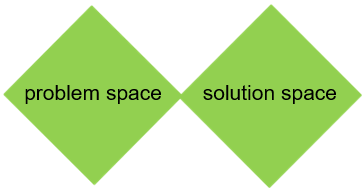
Discover – Define – Develop – Deliver
Diverging – Converging – Diverging – Converging
Explore – Confirm – Explore – Confirm
To understand the relevance of seeing both the problem and solution spaces as deserving of attention, an initial consideration to prepare teams for this journey would be a preliminary Determine step, like a call to adventure before embarking on what she calls growing from adversities, assembling a team of allies, and giving back to society (Lelis 2022: 54-55). For this SEED course on Entrepreneurship for a Sustainable Future, promoting this spirit of growth is recommended.
Teachers can help by providing opportunities for dedicated practice in class through teamwork. For example, to practice diverging, where each team expands their possibilities and generates new ideas, the students must exercise a mindset that not only defers judgment, finding unusual and even wild and crazy ideas, but also strives for quantity by building on their ideas and writing it all down in big letters for the entire team to see and move around to establish connections.
When teams practice converging, they make sense of what they learned and refine their ideas, with a mindset that is affirmative and deliberate about checking objectives and improving ideas that could lead to novelty.
The site specifically designed to support students who aim to practice working with design thinking, Design Thinking for Higher Education (Nusselder and Arau Ribeiro 2020), offers strategies to help teams avoid the pitfalls of jumping immediately to the solution space. The rationale is that, by accepting the opportunity to better understand the problem in a wicked challenge, better solutions can be discovered. These strategies include, for example, Preparing the brief, Imagining a day in the life, Remembering the future, Framing the question, Exploring the field, Saturating your space, Finding a point of view, Ideating, Critical thinking, Iterating, and Storytelling.