SEED Guide
1. SEED course material: Entrepreneurship for a Sustainable Future
Based on the Erasmus+ project on Sustainable Entrepreneurship in Education (SEED), sequential SEED lectures on Sustainability Unleashed, Exploring Empathy, Igniting Innovation, and Bringing Solutions to Life are supported by the relevant topics inspiring the SEED Sustainability Challenges and the SEED Case Studies through the prism of design thinking strategies.
As teachers of the SEED course on Entrepreneurship for a Sustainable Future, you are encouraged to build your modules and courses through a number of choices from amongst the following course components:
- 4 lecture templates that you can adapt to your own teaching style
- 4 video lectures with accompanying transcripts
- 12 sustainability challenges
- 72+ design thinking tasks
- multiple associated tools
- 10 case studies
- 100 discussion questions
- 100+ further readings and references.
Using the entire course is estimated to be equivalent to 3 ECTS (from the European Credit Transfer System, which includes student workload in class and outside of class).
This comprehensive resource has been crafted to empower educators in implementing design thinking principles in the classroom with Sustainable Entrepreneurship Challenges. Designed to inspire creativity, critical thinking, and problem-solving skills among students, this SEED guide serves as your roadmap. Throughout, you will find a wealth of instructional materials, strategies, and activities carefully organized to support your journey in integrating design thinking methodologies into your teaching practice.
This SEED course on Entrepreneurship for a Sustainable Future blends the results of recent research that supports teaching sustainability itself through design thinking (Manna, Rombach, Dean, and Rennie 2022) and provides an extensive description of each of the steps. Other suggestions from literature on working with sustainability problems find that, when scaffolded, creative confidence is an outcome of the Design Thinking (DT) process as demonstrated in the figure below.
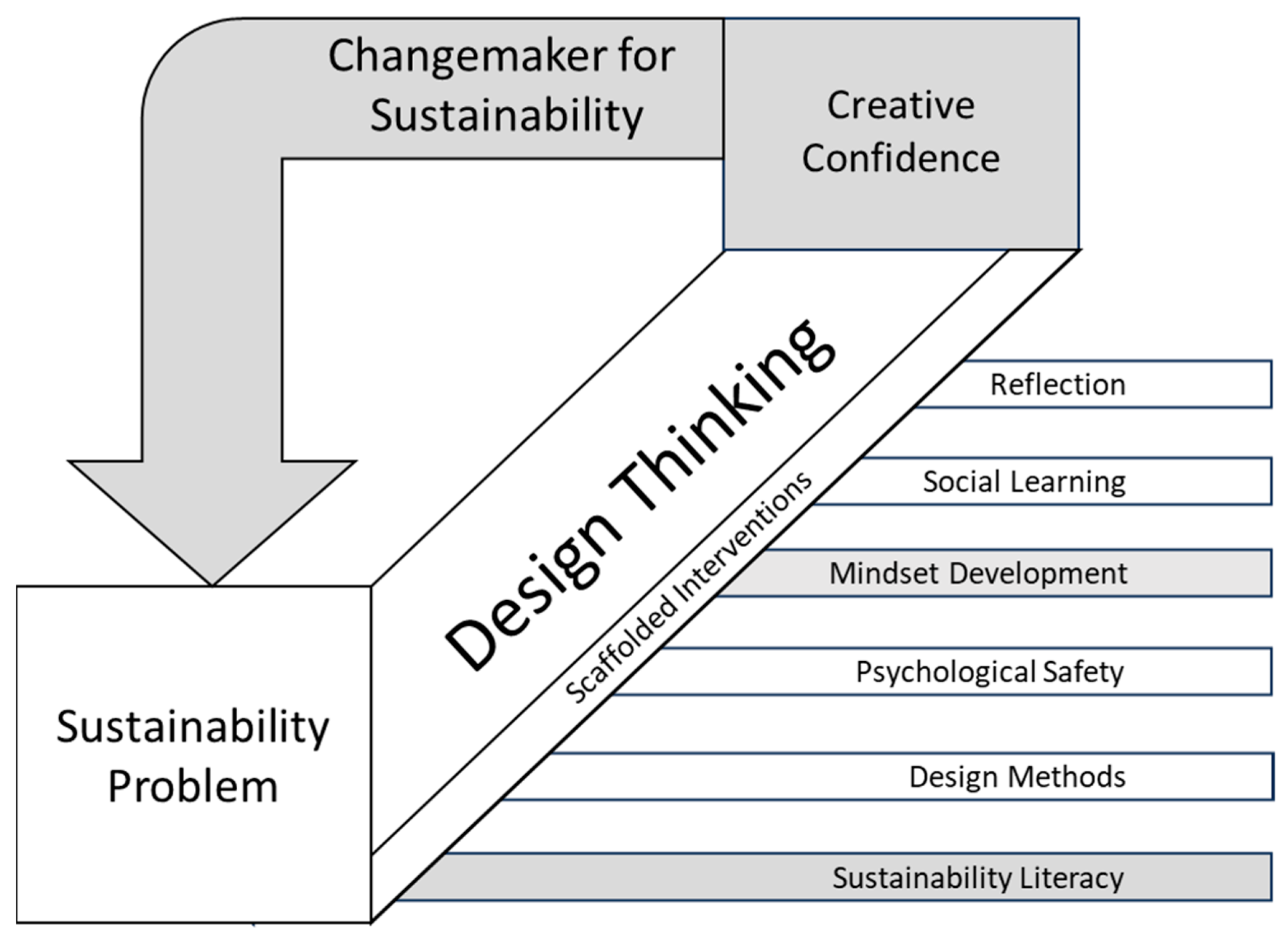
Source: Macagno, Nguyen-Quoc, and Jarvis (2024)
Note that for training the future skills involved in promoting sustainability, interculturality, and innovation, teachers can apply a digital design thinking format (Arau Ribeiro et al. in Pokrzycka 2020; Steuer-Dankert 2023).
Explore the potential of the design thinking activities suggested in Chapter 4 on Applying Design Thinking. In addition to a broad selection of tasks and tools, described clearly so that you can follow the guide step-by-step, the accompanying tips for teaching may be useful for teachers who are new to design thinking