SEED Guide
| Site: | SEED |
| Course: | Design Thinking Lab |
| Book: | SEED Guide |
| Printed by: | Guest user |
| Date: | Friday, 9 October 2026, 5:20 PM |
Description

Using Design Thinking
to Solve Sustainability Challenges
Table of contents
- Using Design Thinking to Solve Sustainability Challenges
- 1. Using the SEED Guide
- 2. Introducing Learning Outcomes
- 3. Aligning Assessment
- 4. Applying Design Thinking
- 4.1. Preparing for Design Thinking: Lateral thinking, diverging, and converging
- 4.2. Teaching with Design Thinking: Strategies, tools and techniques
- 4.2.1 Empathizing
- 🪴 Empathizing templates
- 4.2.2. Re-defining to understand
- 🪴Re-defining templates
- 4.2.3. Ideating
- 4.2.4. Prototyping
- 4.2.5. Evaluating
- 💎 Evaluating templates
- 4.2.6. Implementing
- 🪴Implementing templates
- 4.3. Collected list of links to previously published tools and orientations
- 5. Design thinking in practice
- 6. Selected references
- 7. About the SEED Erasmus+ project
The SEED Guide to Entrepreneurship for a Sustainable Future
María del Carmen Arau Ribeiro
Paula Coutinho
Natália Gomes
Noel Lopes
Clara Silveira
Fernando Marcos
Marina Candi
Elfa Frið Haraldsdóttir Roum
Réda Juodkūnienė
Deimantė Žilinskienė
This part of the project has been co-funded by the Erasmus+ Programme of the European Union. This publication reflects the views only of the authors. The National Agency and European Commission cannot be held responsible for any use which may be made of the information contained therein.
PUBLICATION FREE OF CHARGE
Please cite as:
Arau Ribeiro, María del Carmen, Paula Coutinho, Natália Gomes, Noel Lopes, Clara Silveira, Fernando Marcos, Marina Candi, Elfa Frið Haraldsdóttir Roum, Réda Juodkūnienė, and Deimantė Žilinskienė, Using Design Thinking to Solve Sustainability Challenges: The SEED Guide to Entrepreneurship for a Sustainable Future.
Linguistic revision of the SEED Guide by María del Carmen Arau Ribeiro.
With special thanks to the collaboration of the students and teaching assistants in the seven Applied English courses in the areas of Cybersecurity (I and II), Computer Engineering, Clinical Analyses, Auto Repair & Maintenance, Intermediate English, and Academic International Topics at the School of Technology & Management (ESTG) of the Guarda Polytechnic University (IPG) in Portugal in the year 2023-2024.
1. SEED course material: Entrepreneurship for a Sustainable Future
Based on the Erasmus+ project on Sustainable Entrepreneurship in Education (SEED), sequential SEED lectures on Sustainability Unleashed, Exploring Empathy, Igniting Innovation, and Bringing Solutions to Life are supported by the relevant topics inspiring the SEED Sustainability Challenges and the SEED Case Studies through the prism of design thinking strategies.
As teachers of the SEED course on Entrepreneurship for a Sustainable Future, you are encouraged to build your modules and courses through a number of choices from amongst the following course components:
- 4 lecture templates that you can adapt to your own teaching style
- 4 video lectures with accompanying transcripts
- 12 sustainability challenges
- 72+ design thinking tasks
- multiple associated tools
- 10 case studies
- 100 discussion questions
- 100+ further readings and references.
Using the entire course is estimated to be equivalent to 3 ECTS (from the European Credit Transfer System, which includes student workload in class and outside of class).
This comprehensive resource has been crafted to empower educators in implementing design thinking principles in the classroom with Sustainable Entrepreneurship Challenges. Designed to inspire creativity, critical thinking, and problem-solving skills among students, this SEED guide serves as your roadmap. Throughout, you will find a wealth of instructional materials, strategies, and activities carefully organized to support your journey in integrating design thinking methodologies into your teaching practice.
This SEED course on Entrepreneurship for a Sustainable Future blends the results of recent research that supports teaching sustainability itself through design thinking (Manna, Rombach, Dean, and Rennie 2022) and provides an extensive description of each of the steps. Other suggestions from literature on working with sustainability problems find that, when scaffolded, creative confidence is an outcome of the Design Thinking (DT) process as demonstrated in the figure below.
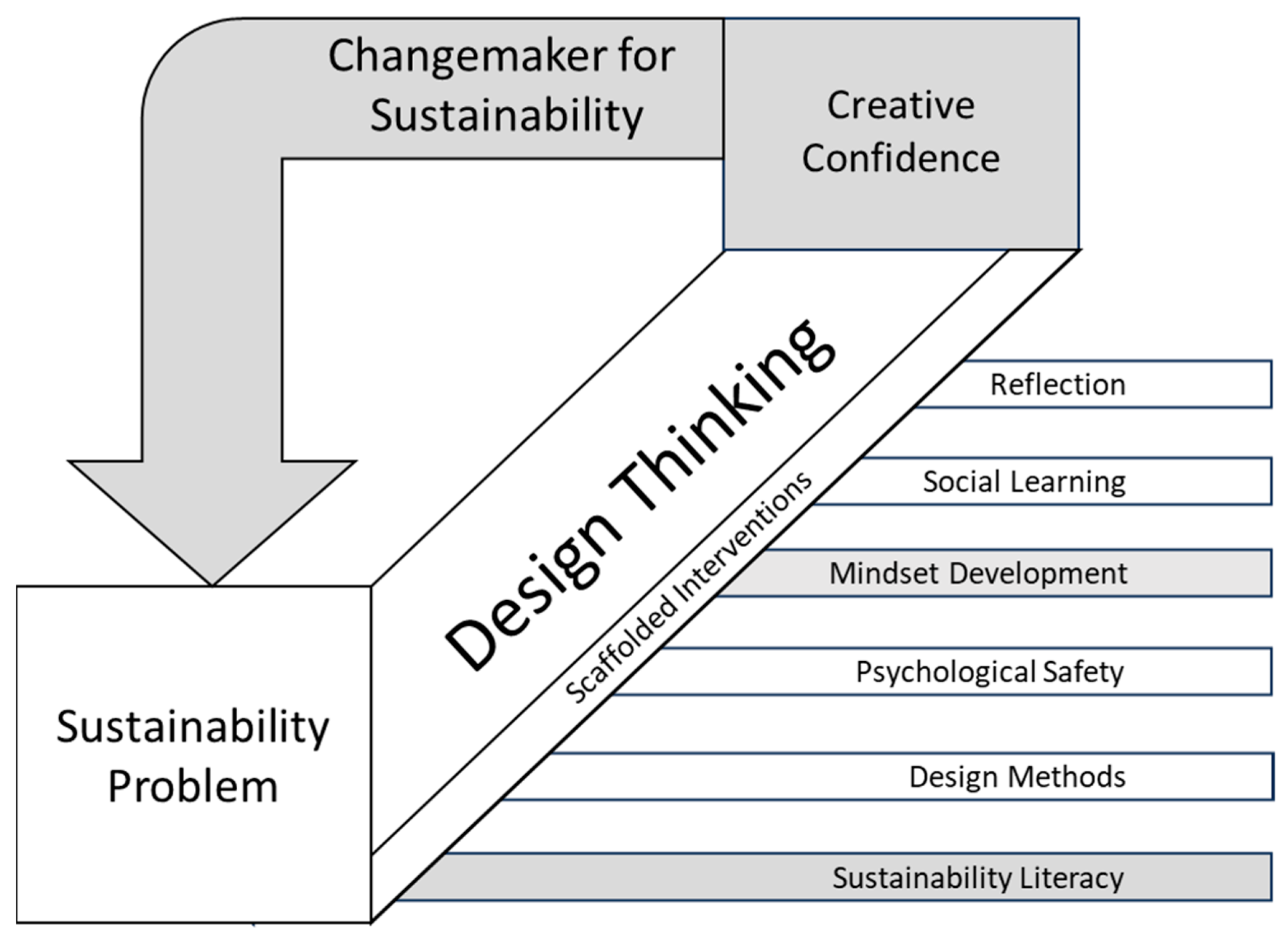
Source: Macagno, Nguyen-Quoc, and Jarvis (2024)
Note that for training the future skills involved in promoting sustainability, interculturality, and innovation, teachers can apply a digital design thinking format (Arau Ribeiro et al. in Pokrzycka 2020; Steuer-Dankert 2023).
Explore the potential of the design thinking activities suggested in Chapter 4 on Applying Design Thinking. In addition to a broad selection of tasks and tools, described clearly so that you can follow the guide step-by-step, the accompanying tips for teaching may be useful for teachers who are new to design thinking
1.1. SEED Lectures
You can use the SEED video lectures and/or select and further develop the SEED lecture templates to match your teaching style from the sequence of inspiring lectures that gradually integrate advancing contexts in building Entrepreneurship for a Sustainable Future:
✅ Sustainability Unleashed (Novice)
✅ Exploring Empathy (Beginner)
✅ Igniting Innovation (Intermediate)
✅ Bringing Solutions to Life (Advanced)
The SEED lectures and SEED Sustainability Challenges are organized by difficulty, from Novice (🟊) and Beginner (🟊🟊) to Intermediate (🟊🟊🟊) and Advanced (🟊🟊🟊🟊).
The Novice (🟊) Sustainability Challenges are an apt introduction to sustainability.
The Beginner (🟊🟊) Sustainability Challenges include the population of a business model.
The Intermediate (🟊🟊🟊) and Advanced (🟊🟊🟊🟊) Sustainability Challenges also involve starting a new business.
The Advanced (🟊🟊🟊🟊) Sustainability Challenges incorporate a multiplicity of perspectives and possibilities.
1.2. SEED Sustainability Challenges
To use the 12 SEED Sustainability Challenges in your course, we offer the following notes:
- Select from the sustainability challenges to build a course or course module tailored to your students’ needs. For example, students can work on just one Sustainability Challenge throughout the course or be introduced to up to 12 Sustainability Challenges from this list:
|
Novice Sustainability Challenges ✅ Green Office Practices ✅ Eco-Friendly Event Planning ✅ Green Home Gardening |
Intermediate Sustainability Challenges ✅ Zero-Waste Personal Care ✅ Sustainable Grieving Practices ✅ Innovative Urban Mobility Solutions |
|
Beginner Sustainability Challenges ✅ Sustainable Pet Ownership ✅ Campus Food System ✅ Sustainable E-commerce Packaging |
Advanced Sustainability Challenges ✅ Carbon-Neutral Urban Redevelopment ✅ Sustainable Transformation of the Fashion Industry ✅ Zero-Waste Toy Manufacturing |
- Discover whether your students have experience working with sustainability, entrepreneurship, and/or design thinking through an initial needs analysis. Since the launch of Stanford University’s d.school in 2008 and the European-wide work of the Erasmus+ DT.Uni project, more students have at least heard of design thinking but may not have yet had the chance to actually work with it hands on. Their level of familiarity with these topics will help you make choices as you build your materials.
- Use the SEED Sustainability Challenges sequentially or build your own course by choosing the levels, experience with business, and topics according to the needs analysis of the students in a specific course.
- Ensure that students develop critical and entrepreneurial thinking in response to sustainability challenges. The Novice (🟊) and Beginner (🟊🟊) levels of the SEED Sustainability Challenges are appropriate for improving existing businesses or to pursue an innovative product or service within a company (intrapreneurship) while the Intermediate (🟊🟊🟊) and Advanced (🟊🟊🟊🟊) levels target new businesses or develop a concept for a new business (entrepreneurship).
- If you do not have the freedom or flexibility to use the full SEED course, begin with just one module. The positive experience will be enough to encourage you to add still more.
The 12 SEED Sustainability Challenges and the accompanying design thinking tools, tasks, and steps have been piloted with nearly 100 students in eight different courses of Applied English at the Guarda Polytechnic University (IPG) School of Technology and Management. For these piloting activities, teachers, administrators, researchers, members of the local community, 2-year specialization students, BSc students, and MSc students collaborated in design thinking workshops in co-creation with glocal (global and local) stakeholders in the two semesters of the academic year 2023-2024. In the period just before publication, in May 2024, the material was fine-tuned with a final piloting activity, co-funded by the SEED Erasmus+ project, led by IPG at Reykjavik University’s Center for Research on Innovation and Entrepreneurship (RUCRIE), Iceland.
Note specifically the following encouraging notes from the piloting and follow-up focus group discussions:
- Students in our piloting processes were engaged, citing teamwork, holistic learning and growing self-awareness as well as confidence-building in autonomous acquisition of knowledge and vocabulary as specific added value.
- The autonomy other participants pointed to also involved growing interdependence that allowed them to trust their teammates, which was pointed out as an inspiring way to work together, where judgment is reserved, errors are not an embarrassment but embraced as opportunities for improvement, and collaboration is favored.
- Left to work individually for a week-long assignment on the SEED Sustainability Challenges, the overwhelming majority of the focus groups of students admitted to having consulted AI as an imaginary teammate instead of working in isolation. These AI-queries, for example, involved simulating alternately a fountain of unfiltered ideas or a devil’s advocate position according to the instructions initially provided by each student.
- Despite the convenience of leveraging AI on their own time, the students overwhelmingly preferred the work done with in-person teams, where they could read body language and communicate more freely. They also remembered the work they had done much more effectively when working on a team.
1.2.1 SEED Design Thinking Canvas – SEED DTC
A template specifically designed for the SEED project represents the culmination of each of the 12 SEED challenges in a SEED Design Thinking Canvas (DTC). The SEED DTC guides design thinkers through the process of applying design thinking principles to address challenges, emphasizing the Triple Bottom Line (TBL/3BL) focus on People, Planet, and Profit.
1.2.1 SEED Design Thinking Canvas – SEED DTC
The SEED DTC facilitates a comprehensive approach to problem-solving by guiding design thinkers through the various stages of design thinking. Design thinkers can feel confident that their creative solutions are human-centered, sustainable, and economically viable, aligning with the principles of the Triple Bottom Line (TBL/3BL).
The following step-by-step introductions for the SEED DTC give an overview of how to tackle SEED challenges:
|
SEED Design Thinking Canvas – SEED DTC |
|
Identify how the challenge addresses...
1. Empathizing with a variety of DT tools from section 4.2.1. For example:
→ Key Insights: Capture the most critical learnings from the empathy phase.
2. Re-defining to Understand with a variety of DT tools from section 4.2.2. For example:
→ New Perspective: Summarize the refined understanding of the problem or challenge.
3. Ideating with a variety of DT tools from section 4.2.3. For example:
→ Key Idea: Identify the most promising idea to move forward with.
4. Prototyping with a variety of DT tools from section 4.2.4. For example:
→ Areas for Improvement: Identify aspects of the prototype that need enhancement.
5. Evaluating with a variety of DT tools from section 4.2.5. For example:
→ Results of evaluation: Record the outcomes of the evaluation process. 6. Implementing with a variety of DT tools from section 4.2.6. For example:
→ Observations: Observe and record insights from the implementation phase. |
1.3. Design Thinking Approach
A Design Thinking process usually starts with a challenge, which gives focus and direction. We are working with six different interconnected phases of the process.
Become familiar with the six phases in each challenge that follow the 3i Approach to Design Thinking, where interdisciplinary teams engage in innovation through (re)iteration, in a design thinking model designed under the coordination of the Guarda Polytechnic University (IPG, from the Portuguese Instituto Politécnico da Guarda) partner team for the Erasmus+ project DT.Uni: Design Thinking Approach for an Interdisciplinary University (2017-2020, nº 2017-1-PL01-KA203-038527).
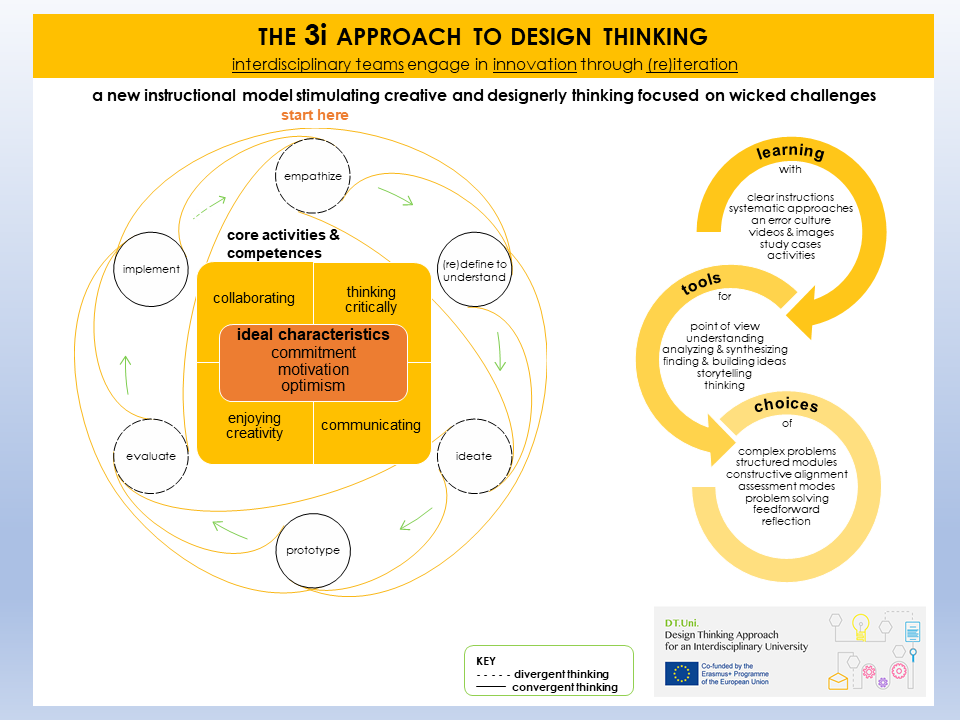
Source: https://portal.ipg.pt/DTtasks/DTmodel
The 3i approach reinforces your own awareness that, when possible, engaging students from different areas of study can broaden the representation of perspectives, which in turn enriches learning with more challenging interaction. The innovation target of design thinking meets the specific purposes of innovating in existing businesses or creating new businesses in this SEED course on Entrepreneurship for a Sustainable Future. Finally, the (re-)iteration at the heart of the 3i approach reinforces the “fail fast” ethos of a successful error culture (Arau Ribeiro and Fisher 2021), where mistakes are an opportunity to improve and learn rather than a reason for punishment. Note that “an open error culture is a crucial building block for reducing project failures and serious errors and for increasing organizational success” (Hagen 2022).
The ideal characteristics of commitment, motivation, and optimism are allied to the core activities and competences promoted through this SEED course on Entrepreneurship for a Sustainable Future; as the teacher, you will want to assure that your students are enjoying creativity, thinking critically, communicating, and collaborating on teams.
The construction of a learning environment that includes diverse materials, clear instructions, and systematic approaches in a successful error culture will adjust to find the right blend of tools for expressing points of view, understanding, analyzing and synthesizing, finding and building ideas, storytelling, and thinking. The learning environment and tools will be accompanied by choices that teachers and students make together regarding the complex problems, structured modules, constructive alignment, assessment modes, problem solving, feedforward, and reflection. The six steps include the (re)iterative DT activities of empathizing, (re)defining to understand, ideating, prototyping, evaluating, and implementing. Each DT step is supported by the suggested tasks and tools and a step-by-step description to help you as you help your students (see section 4.2).
The first phase of empathizing requires teams to explore, collect insights and understand the problem they intend to solve, and to get to know the users who will benefit from that solution. A user-centric perspective, namely by using tools like Persona development and other empathizing tools, helps to understand how users feel and effectively identifies their motivations and needs (Bruchatz, Fischer, and Stelzerref 2019; Manna, Rombach, Dean, and Rennie 2022).
Potential solutions to the identified problems are planned in the ideating phase dedicated to creation. In addition to formulating hypotheses about problems to be solved, you also conceptualize and organize them through more interviews, brainstorming, and brainwriting as well as tools like Kill your Idea, the Matrix Scale, and Send a Text. Ideation tools like brainstorming encourage full team participation, generating and collecting many new ideas without the threat of judgment or dismissal of ideas. When the team has generated as many potential solutions as possible, then these possibilities are organized, evaluated, and selected for their suitability through dot-voting. Two important results become apparent at this stage: Teams have a solid understanding of the users’ problems and needs. The teams will have also created a user-centric problem statement using tools, like the How might we…? question.
Then, by creating actual prototypes to implement the teams’ hypothetical solutions, their creativity is critically explored before advancing to the evaluation phase reserved for testing the prototype and, when possible, validating it with potential or even simulated users. Since solutions can be rejected, accepted, and/or improved, evaluating is also the starting point for changes, leading to a new iteration and beginning the process anew to improve and/or to redevelop ideas.
In the SEED Guide, links are provided to online tools for ease of reproduction. In general, we recommend the design thinking approaches and templates published by Bruchatz, Fischer, and Stelzer (2019: 85-109) and Nusselder and Arau Ribeiro (2020). The templates in these publications, respectively coordinated by the Center for Synergy Enhancement, Technische Universität Dresden (TUD) and from a joint UvA-IPG production (University of Amsterdam and Guarda Polytechnic University), were tested and refined in pilot courses and student and teacher training workshops of the DT.Uni Erasmus+ project (2017-2020) to provide clear and easily reproducible tools that gather and analyze information at each step in the challenges. As a project that concluded during the Covid-19 confinement, the consortium of eight universities in eight countries rose to the challenges of emergency remote teaching and, thus, managed to pilot test the Open Educational Resources (OER) in online and in-person teaching modes. Note that, rather than printing out visualization tools, you may prefer to engage students by giving them the opportunity to draw out and develop their own visual representations on paper to learn more about each given tool and its purpose(s).
We also highly recommend reviewing the following:
- how to better understand design thinking through the lens of experiential learning (ExL) theory (Dzomback and Beckman 2020)
- the interplay in the innovation process between problem framing and empathy manifestation (Kim et al. 2020)
- problem framing and developing the related essential skills of empathy, insight recognition, thinking divergently, and learning through failure (Beckman and Barry 2012)
- quality improvement through design thinking (Crowe et al. 2022)
1.4. SEED Case Studies of applied design thinking
The case studies created for the SEED course on Entrepreneurship for a Sustainable Future aim to enhance awareness and critical thinking for working with design thinking approaches. The case studies explore how a variety of private companies and public entities have applied human-centered design approaches to launch new products and services on the market.
Like the SEED Sustainability Challenges and the accompanying design thinking tools, tasks, and steps, the SEED Case Studies, further readings, and discussion questions have been piloted with 50+ students in four different courses of Applied English at the Guarda Polytechnic University (IPG) School of Technology and Management. For these piloting activities, teachers, administrators, researchers, members of the local community, 2-year specialization students, BSc students, and MSc students collaborated in design thinking workshops in co-creation with glocal (global and local) stakeholders in April and May 2024. In the same period before publication, the material was fine-tuned with a final piloting activity, co-funded by the SEED Erasmus+ project, led by IPG at Reykjavik University’s Center for Research on Innovation and Entrepreneurship (RUCRIE), Iceland.
This additional course material, developed to support the joint objectives of learning and practicing design thinking aimed at sustainability and entrepreneurship, is comprised of three components to enrich learning:
- ten case studies in 1-2 pages each
- a variety of further reading selections for each selected industrial or organizational area
- ten discussion questions tailored to each case study.
Teachers can use these three components in diverse combinations. Here are just a few sample lesson ideas:
The ten SEED Case Studies can be read sequentially or you can pick and choose to use them individually to warm up to other aspects of the SEED course lectures or SEED Sustainability Challenges.
The ten discussion questions that complement each case study can be summarily completed in individual practice, whether in class or as an assignment.
Teams can build their responses collaboratively and debate their results with other teams.
Teams can discuss and select their favorite question(s) for rival teams to respond to.
Teams can be asked to develop more and better questions for discussion.
Discussion of the responses can occur in a speed-dating context, where discussion partners switch in a 1-3 minute period, orchestrated by the teacher or by a student. This time-frame is valued especially as the famous elevator pitch so clearly merits practice time.
Teams can develop infographics that interpret the design thinking process for one or more of the ten SEED Case Studies.
Predictably, in contrast to working alone, teamwork has proven to be the most effective approach to using the case studies. The students had more fun thinking together and produced a greater variety of ideas than individually. Focus groups responded invariably that their training in design thinking had convinced them of the value of teamwork.
The piloting results clearly favor the memorable heated discussions and enriching development of the themes proposed.
Dedicating class time to these components is highly recommended. Note that the core activities and competences of design thinking, according to the 3i Approach to Design Thinking, are collaborating on teams, communicating, thinking critically, and enjoying creativity. Keep in mind that, as examples of design thinking in action, the ten case studies each represent opportunities to generate discussion and witness the systematic development of empathy (in the problem space) and ideas (in the solution space) of a specific wicked challenge.
As you work with these design thinking case studies, please consider the irony expressed in this recent book title: The Feeling Economy: How Artificial Intelligence is creating the Era of Empathy (Rust and Huang 2021). According to co-author Roland Rust, “As AI evolves to handle much of the thinking required in fields from manufacturing to retail to healthcare, humans will need to recalibrate and capitalize on strengths beyond pure intelligence — like intuition, empathy, creativity, emotion and people skills” (Smith 2021).
2. Matching teaching to the proposed SEED learning outcomes
The comprehensive set of learning outcomes aims to align with the dynamic nature of entrepreneurship and prepares students to navigate and thrive in a competitive business environment. Working with a design thinking approach, students will practice and learn to wield a wide range of creative and critical skills and knowledge areas, providing a well-rounded foundation for aspiring entrepreneurs. The objectives cover the importance of social responsibility, integration of well-being initiatives, innovation, research and development (R&D), and market analysis — all essential components of successful sustainable business ventures. The proposed learning outcomes for the SEED course on Entrepreneurship for a Sustainable Future, created in collaboration with university students, are as follows:
- Recognize and adapt to emerging technologies and industry trends by creating innovative and sustainable opportunities through design thinking activities.
- Apply effective strategies and skills in research and development to create sustainable, impactful solutions.
- Conduct comprehensive market research and analyze competitive intelligence to position sustainable ventures effectively within industry.
- Build strategic integration into entrepreneurial ventures through social responsibility, well-being initiatives, and sustainable practices.
- Assess the impact of sustainable entrepreneurship on business success.
- Devise ways to maintain a competitive edge in the dynamic business landscape by consistently meeting market demands.
To address key issues in social responsibility and well-being, the learning outcomes include ethics, stakeholder engagement, diversity and inclusion, environmental sustainability, and regulatory compliance. For professional development and industry R&D, the learning outcomes include innovation, market analysis, legal considerations, project management, and sustainability integration.
These learning outcomes are purposely built on measurable learning objectives, expressed as active verbs and adapted to support developmental assessment based on New Bloom’s Taxonomy (Anderson and Krathwohl 2001). Following backwards design process for course development (Wiggins and McTighe 2005), the desired results − learning objectives, ideas, skills − serve to inform a priori the definition of tasks and learning events in tandem with a taxonomy of significant learning outcomes (Fink 2003) and seven ways of learning (Davis and Arend 2013).
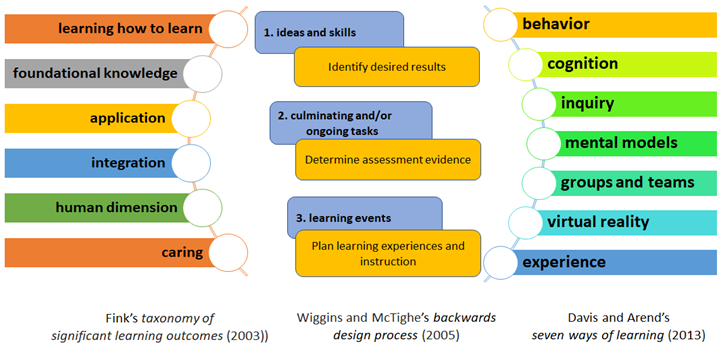
Source: Arau Ribeiro et al. (2020: 14)
The overall learning objectives are enriched through four lectures and twelve SEED Sustainability Challenges, each with six steps of design thinking tasks and tools. Each lecture proposes specific learning outcomes which are further developed in the specific learning outcomes of each challenge.
To consider the four different sets of learning objectives across the modules, the collected focuses for each of the four modules are copied in the table that follows. Based on the titles of the four modules across the top of the table, the columns that follow can be consulted to help you pick and choose as you build your own SEED course.
Learning Outcomes in each SEED module
|
Sustainability Unleashed |
Exploring |
Igniting |
Bringing Solutions |
|
Understand the foundational concepts of entrepreneurship and sustainability. |
Understand the importance of empathy in the context of sustainability challenges. |
Understand the importance of both critical and creative thinking in addressing and solving sustainability challenges in the context of entrepreneurship. |
Demonstrate the ability to create low-fidelity prototypes for sustainable solutions, applying practical skills in prototyping to visualize and test ideas. |
|
Explain the relationship between sustainability and entrepreneurship, particularly within the context of the Triple Bottom Line framework (People, Planet, Profit). |
Proficiently employ tools such as interviews and observations to conduct empathetic research. |
Develop the ability to effectively redefine sustainability problems, turning vague or complex issues into clear, actionable challenges ready for innovative solutions. |
Apply evaluation techniques that leverage constructive criticism and adaptability to elicit feedback/feedforward on prototypes to be incorporated into the iterative design process for refining and improving sustainable solutions. |
|
Familiarize themselves with the core principles of Design Thinking, including the 6 stages: Empathizing, Re-defining to Understand, Ideating, Prototyping, Evaluating, and Implementing. |
Effectively articulate and define sustainability problems for entrepreneurial solutions. |
Gain proficiency in ideation techniques such as brainstorming and mind mapping to find creative and practical solutions to sustainability challenges. |
Understand and execute the steps involved in implementing a sustainable solution, from developing a stable version of the product or service to launching it on the market. |
|
Develop an awareness of how Design Thinking can be applied to address sustainability challenges effectively. |
|
Grasp the fundamentals of the Circular Economy and the Sharing Economy to identify how these models can contribute to sustainable business solutions. |
Develop strategies for scaling sustainable solutions, including identifying potential barriers and opportunities along the path forward growth and impact amplification. |
|
Begin to cultivate a mindset conducive to empathetic problem-solving for sustainable entrepreneurship. |
|
Combine understanding of sustainability and innovation to create new businesses that are sustainable, profitable, and socially responsible. |
Measure the impact of sustainable solutions, utilizing appropriate metrics and tools to assess environmental, social, and economic benefits. |
|
|
|
Design-Thinking to accelerate solutions for the UN’s Sustainable Development Goals |
Exhibit an iterative design thinking mindset, recognizing the importance of continuous improvement and adaptation in the development of sustainable solutions. |
3. Aligning your teaching with the proposed SEED Grading Rubric
The SEED Grading Rubric is designed for simultaneous learning and assessment, just as language learners have become increasingly familiar with self-assessment for levels A1-A2-B1-B2-C1-C2 (CEFR CoV 2018).
Discussing and debating the objectives will contribute to motivation and direction when you aim for your students to actively engage in learning activities. Be sure to share the SEED Grading Rubric and make time in class for questions and answers that improve understanding of authentic assessment. The rubric can also be a source of advance learning, explanation, and stimulus as students apply the rubric to their own work and possibly in other areas where they are pursuing innovation and excellence.
Note the scale from zero to three (top row) recognizes zero (0) as the total absence of a component of the grading rubric, which is especially relevant for teams that have not yet developed that part of their proposal. Level zero in each area is characterized by terms such as lack of, flawed, insufficient, missing, limited, and not addressed. In planning the lesson, you could consider the value of allowing teams to prepare a 2.0 follow-up version after their project presentations in an attempt to promote improvement and more holistic learning in a successful error culture.
The scaled assessment above zero, from one to three (1-3), recognizes the increasing levels of success in the areas of assessment (left column) in seven areas. The SEED Grading Rubric includes assessment of the risk-taking and boundary crossing required to engage in exploring new areas, divided to account for successful teamwork and communication in identification, coordination, reflection, and transformation as follows:
✅ Risk-taking: Identification and Reflection
Key entrepreneurship issues precisely articulated. Deep understanding of personal and group learning.
✅ Boundary crossing: Coordination and Transformation
Diverse boundaries, coordinated and transformed; coordinated collaboration plans; learning applied to real-world scenarios with innovative thinking and adaptability.
These approaches to sustainability maintain a teaching focus on “stimulating students to go through boundary-crossing learning processes critical for getting a grip on the unpredictable future" (Gulikers and Oonk 2019).
Beyond the assessment of the risk-taking and boundary crossing, the SEED Grading Rubric reflects the fundamental concepts of entrepreneurship for a sustainable future, shown here with maximum assessment levels:
✅ Feasibility
Well-thought-out and feasible solutions proposed, considering potential obstacles and practical implementation.
✅ Market potential
Strong analysis of the target market (including size and characteristics) and market potential for the proposed solution.
✅ Triple Bottom Line (3BL or TBL)
People, Planet, and Profit: All three bottom lines were addressed with thorough and well-researched analysis.
✅ Addressing and solving the challenge
Comprehensive and insightful analysis of challenge-specific metrics directly related to the presented solution to the sustainability challenge.
✅ Novelty
Highly original: Demonstrates a fresh perspective.
As a final consideration of assessment for your SEED course, lifelong learning means that teachers might want to encourage students to reflect on the course and module activities and how they can apply the skills and knowledge they gained in future real-life situations. This could take the form of a final reflection on an exam or as an assignment for the students’ progressive portfolios.
3.1. SEED Grading Rubric
Piloting with students showed that they felt particular interest in “risk taking” and "boundary crossing" in the SEED Grading Rubric. They felt relieved that their initiative and creativity might be recognized through the rubric and that this evidence, when shared in advance, could help to encourage taking risks and ideating in transdisciplinary contexts. They pointed out the confidence it inspired since design thinking especially requires them to engage fully in exploration, curiosity, and impertinent inquisitiveness. The rubric also includes feasibility (covering implementation challenges, potential obstacles, and practical implementation), market potential (including analysis of the target market (including size and characteristics), the Triple Bottom Line (TBL/3BL) of people, planet, and profit, addressing and solving the challenge using challenge-specific metrics, and novelty, tracing their engagement and performance as they learn to reach for innovation in the context of sustainability.
SEED Grading Rubric
Students will be graded on their groups’ solutions to their sustainability challenge in each module according to the rubric below.
|
|
0 points |
1 point |
2 points |
3 points |
|
Risk-taking: Identification and Reflection |
Significant issues are missing; no reflection on the learning experience. |
Limited identification of key issues and reflection. |
Minor gaps in the key issues, Potential for more exploration of further meaningful reflection |
Key entrepreneurship issues precisely articulated. Deep understanding of personal and group learning. |
|
Boundary crossing: Coordination and Transformation |
Flawed or no collaboration plans; insights are not actionable strategies. |
Some coordination but plans suffer from execution challenges; strategies lack innovation or adaptability. |
Potential for effective coordination across boundaries to transform ideas into actionable strategies for sustainable entrepreneurship. |
Diverse boundaries, coordinated and transformed; coordinated collaboration plans; learning applied to real-world scenarios with innovative thinking and adaptability. |
|
Feasibility |
Solutions lack practicality and feasibility; implementation challenges not addressed at all. |
Limited consideration of feasibility; significant implementation challenges unaddressed. |
Some aspects of feasibility considered, but significant implementation challenges remain unaddressed. |
Well-thought-out and feasible solutions proposed, considering potential obstacles and practical implementation. |
|
Market potential |
Limited understanding of the target market and its potential. |
Some understanding of the target market, but minimal exploration of market potential. |
Some understanding of the target market, but market potential not fully explored or articulated. |
Strong analysis of the target market (including size and characteristics) and market potential for the proposed solution. |
|
Triple Bottom Line |
People, planet and profit not considered. |
Limited attention to one or two of the three bottom lines. |
All three bottom lines addressed, but with incomplete or superficial analysis. |
All three bottom lines addressed with thorough and well-researched analysis. |
|
Addressing and solving the challenge |
Insufficient consideration of challenge-specific metrics; lack of relevance to the presented challenge. |
Minimal attention to challenge-specific metrics; limited relevance or depth. |
Some attention to challenge-specific metrics, but limited relevance or depth. |
Comprehensive and insightful analysis of challenge-specific metrics directly related to the presented solution to the sustainability challenge. |
|
Novelty |
Lack of originality: ideas presented are common or unremarkable. |
Limited originality: ideas lack creativity or uniqueness. |
Moderate level of originality: some creative ideas presented. |
Highly original: demonstrates a fresh perspective. |
4. SEED Sustainability Challenges
Each of the 12 SEED Sustainability Challenges are designed for one-page easy reference on paper and on mobile devices. You will find the following:
- A clear title that references the activity and proposed results
- A single paragraph that introduces the challenge, accompanied by an image, which together can inspire conversation and questioning.
- The Objectives and Constraints which are crafted to establish the parameters for the activity.
- Six (6) iterative Design Thinking steps which follow the brief to readily go back as many steps as required to “do it again” is essential to the 3i model of design thinking and its “fail fast” ethos.
The SEED Sustainability Challenges have been crafted to involve the students in role-playing, where the students themselves enact all of the parts. By playing different roles, students have the opportunity to explore other perspectives as they adopt new personas. Note that this approach to the activity facilitates carrying out the tasks in the classroom and even in an online learning environment. Teachers can choose to encourage the use of AI tools, such as ChatGPT, for role-playing.
Implementation of the SEED course involves an interactive lesson, teamwork, presentations and discussions. At every phase, teachers are expected to encourage students to participate actively. Especially in the final presentation and discussion, teachers can consider the option of additional student agency by creating student juries, rather than reserving judgment of other teams for the teacher.
4.1 Preparing for Design Thinking: Lateral thinking, diverging, and converging
Practice with lateral thinking can prepare teams for design thinking by getting them out of their comfort zone. These three resources can be used before, during and after your course:
- "The Astonishing Importance of Challenging Assumptions" (YouTube)
- https://designthinking.nusselder.org/challenging-assumptions/
- https://www.destination-innovation.com/the-top-ten-lateral-thinking-puzzles/
The teams’ divergence and convergence around their ideas for design thinking also requires practice. Creative collaborative work requires teams to travel from expanding their options (diverging) to selecting and refining their choices (converging) so that they can move on. These opposing forces provide the quantity and quality required to come to an eventual solution.
The visual component of design thinking cannot be dismissed and some students find the image described as the “double diamond” iteration helpful to actually see the changing mindset required. Regardless of the terminology used to move through the iterations, the first diamond represents all the work that must be done to empathize and re-define the problem itself and the second diamond is the solution space, which involves ideating, evaluating, prototyping, and implementing.
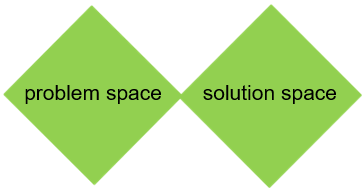
Discover – Define – Develop – Deliver
Diverging – Converging – Diverging – Converging
Explore – Confirm – Explore – Confirm
To understand the relevance of seeing both the problem and solution spaces as deserving of attention, an initial consideration to prepare teams for this journey would be a preliminary Determine step, like a call to adventure before embarking on what she calls growing from adversities, assembling a team of allies, and giving back to society (Lelis 2022: 54-55). For this SEED course on Entrepreneurship for a Sustainable Future, promoting this spirit of growth is recommended.
Teachers can help by providing opportunities for dedicated practice in class through teamwork. For example, to practice diverging, where each team expands their possibilities and generates new ideas, the students must exercise a mindset that not only defers judgment, finding unusual and even wild and crazy ideas, but also strives for quantity by building on their ideas and writing it all down in big letters for the entire team to see and move around to establish connections.
When teams practice converging, they make sense of what they learned and refine their ideas, with a mindset that is affirmative and deliberate about checking objectives and improving ideas that could lead to novelty.
The site specifically designed to support students who aim to practice working with design thinking, Design Thinking for Higher Education (Nusselder and Arau Ribeiro 2020), offers strategies to help teams avoid the pitfalls of jumping immediately to the solution space. The rationale is that, by accepting the opportunity to better understand the problem in a wicked challenge, better solutions can be discovered. These strategies include, for example, Preparing the brief, Imagining a day in the life, Remembering the future, Framing the question, Exploring the field, Saturating your space, Finding a point of view, Ideating, Critical thinking, Iterating, and Storytelling.
4.2. Teaching with Design Thinking: Strategies, tools and techniques
The iterative design thinking steps are selected in lesson planning and can be developed from a selection of diverse and enriching strategies, tools, and techniques, some of which are developed in the introduction to the 3i approach to design thinking). As the teacher, you have an opportunity to influence the integration of design thinking so that it is fun and effective. Because design thinking integrates elements of empathy, creativity, and iteration in a structured framework to guide problem-solving, it is considered to offer a third way to approach problem-solving, beyond (1) a strict focus on analysis and logic to find a single correct solution through rigid, linear problem-solving methods and (2) creative problem-solving methods that emphasize innovation and human-centeredness, like brainstorming sessions, lateral thinking techniques, or frameworks like lean startup methodology.
International experience with design thinking supports the use of a stopwatch. Regardless of the home culture’s perception of time as linear and structured, cyclical, or fluid, time pressure helps to make the teams work more effectively. Respecting time limits forces more intensity and concentration when making decisions or during a creative coffee break talking with other teams.
In each team, the members should decide their collective approach to keeping to the time schedule - whether tight, semi-open, or loose. Teams should practice defining the longest period of time and try shrinking the time frame with experience. When the entire team can see the clock, it serves as a unifying visual attribute for the countdown that amplifies the excitement of completing a task well.
Collaborative tools and materials, like sticky notes in different sizes, shapes, and colors, or a Miro Board, help the team share their thoughts and visualize knowledge and evolution of their design thinking.
On a final note about time, consider creating time for reflection. Some students require time for thought and this is an area where the teacher can observe the teams to suggest appropriate moments for breaks. You will recall that reflection can also be incorporated into aligning your teaching with the proposed SEED Grading Rubric, as part of authentic assessment.
For each of the DT steps, the SEED Guide offers suggestions to enrich your teaching. You will learn about your teaching role through suggestions on teamwork, adjusting goals with design thinking tasks, and developing research hypotheses.
Conducting an efficient team selection of ideas
Teachers should explain the design thinking process so that the teams can benefit from the multiple perspectives and the opportunity to begin anew when iterating in a fail fast error culture. Assure the teams that the steps in the design thinking process are not necessarily sequential although they do serve as a guide through the iterative, non-linear experience. From a teacher’s perspective, and as reinforced by the 3i model, you will notice that the nature of design thinking means teams can repeat the steps and even circle back to previous steps.
Engaged students are likely to be enthused by their work, invested in their team's success, and committed to their objective mission and values. An emotional and mental commitment leads to greater effort and dedication, resulting in better performance and higher productivity. Another strategy for team-building is the naming of the group as they rapidly get to know each other. Ice breakers are a common tool in design thinking to make and maintain team spirit and enhance the classroom context. You can serve as a model to encourage fun and friendly behavior so that team members become more comfortable with each other. Teams that are cohesive are more likely to respect the roles and responsibilities that they decide on based on their strengths and soft skills, transversal skills, and communicative competences. Note that these foundational skills imply adaptive competence since communication includes both verbal and non-verbal communication.
For selecting ideas in a team where diversity of expression is encouraged, dot-voting and brainwriting offer quick pathways to conclusions so that further experimentation can take place.
Adjusting teamwork to the expected results for each task
The iterative nature of the design thinking process helps ensure that the team remains focused on the task goals and can adapt their approach as needed. The alignment of the goals and the results will improve with greater experience in re-iteration, where teams aim to fail fast in an error culture so that they can begin again as early as possible to share and gather diverse perspectives and practice collaborative problem-solving. The variety of ideas, insights, and perspectives to approach tasks from different angles will improve the final result.
Be sure that the teams have taken time to understand the goals and objectives of each task within the design thinking process. Some guiding questions are:
- What problem are you trying to solve?
- What outcomes are you aiming for?
When teams understand the expectations, they can better ascertain how the results of their activities contribute to their overall success. Clearly defining the problem or challenge sets the context for research and focuses the team’s efforts. Re-defining to understand involves ensuring that the problem statement is specific, actionable, and aligned with each team’s project goals. Lists of questions might consider factors such as the impact on end-users, feasibility of answering the question, and alignment with project goals. Note that Opportunity Statements and How might we…? questions are important techniques for reframing challenges as opportunities, where the hypotheses that are generated help to spark creative thinking and exploration
Teams can better synchronize their work when they have also established specific success metrics for each task. These metrics should be measurable and tied directly to the goals they have identified. For example, if the goal is to improve user experience, success metrics could include metrics like user satisfaction scores, task completion rates, or reduction in user errors.
Helping the teams develop ideas through testing
Multiple suggestions for evaluating will help the teams develop their ideas through testing so that implementation occurs when the project is fully developed. Early and often are good descriptors so that teams remember to prototype and test their ideas early and often. When an iterative design thinking process is not followed and testing happens late, teams miss out on the advantages of regularly testing their ideas. Throughout all the phases of the design thinking process, testing and questioning helps to develop and redefine concepts, ideas, and prototypes as potential solutions. When used often and experimentally, testing creates opportunities to see how potential users accept and interact with different potential solutions, resulting in more opportunities to re-iterate through the design thinking process and gather feedforward for improvements. Note that the feedforward results from encouraging constructive feedback so that the team can move toward testing the suggestion.
Developing valuable research hypotheses with the team
The design thinking process itself will guide teams in developing valuable research hypotheses in their teams, reinforced by the core characteristics of commitment, motivation, and optimism in the 3i approach to design thinking. Teachers play a fundamental role in reinforcing and providing guidance to cultivate this mindset that welcomes diverse perspectives and sources of inspiration. The supportive environment where ideas are nurtured and explored as hypotheses could generate more potential innovation.
A focus on the user is essential to build an understanding of the needs and preferences of target users or stakeholders. The time dedicated to exploring empathy in real and/or simulated interviews, surveys, or observations can serve to gather these insights. With teacher support, teams can be encouraged to iterate on their hypotheses based on this feedback/feedforward in their research findings to steadily refine and adapt their insights.
Relevant resources, from case studies to expert opinions and useful tools, should be plentiful and readily available to the teams. Nevertheless, teams should be encouraged to critically evaluate these resources and integrate existing knowledge into their projects whenever possible. Collaborative discussions and debates that challenge assumptions will encourage alternative perspectives for interpreting and using the resources. Critical thinking and open-mindedness are important to foster innovation.
4.2.1 Empathizing
In this first step, the teams will be exploring how the current problem affects the stakeholders, especially the users, defined as those who are suffering or otherwise impacted by the existing problem. While looking for patterns and anomalies, empathizing may require role-playing the part of the user if the students are not personally affected by the problem in the challenge. Note that, when possible, finding real users to determine the user experience can reveal further unknowns.
|
Empathizing: Tools |
Tasks and Steps |
|
Warming up for Brainstorming |
1. Warm-ups are fun! And in the discipline and on-going practice to become a pro. 2. In addition to the six linked exercises, try Self-portrait and Crazy 8s. |
|
Brainstorming |
As the most well-known technique, some rules are important to follow: 1. Create a space that is conducive to brainstorming, free from distractions and with ample space for collaboration. 2. Do not judge at this point of exploration: suspend judgment, defer criticism, and build on each other's ideas. Consider the storm of ideas as an activity aiming for quantity. Later you will have opportunities to curate your list. 3. Writing ALL of the ideas is important to engage visualization and tracking of these ideas. Why not dedicate a column or a wall, even a table to getting all of the ideas written down? Teams may appreciate tools such as whiteboards, sticky notes, markers, and flip charts to facilitate idea generation and visualization. 4. This activity should help the team to gain a deeper understanding of the problem, its root causes, and potential solutions. 5. Start the brainstorming session with a warm-up exercise to stimulate creativity and get participants into a creative mindset. |
|
User Interviews (see template below) |
1. To clearly define the objectives of the user interviews. consider the following before you begin: ➢ What specific information are you seeking to gather? ➢ What are your goals for conducting these interviews? ➢ Who is the target audience or user group for the product or service? Consider demographics, behaviors, and needs to ensure that your interviews represent the diversity of your user base. 2. Align the objectives with the overall goals of your design project. Whenever possible, a qualitative interview should be conducted with two interviewers. 3. Contact your interviewees and set a schedule that is convenient for them in a comfortable and neutral environment where they can feel relaxed and open to sharing their thoughts and experiences. 4. Structure an Interview Guide beginning with broad, open-ended questions to build rapport with the participant. When the interaction has been positively charged, the interview can move into more specific areas of interest. 4. Prepare questions that address new user-centered needs. 5. Be open-minded so that you can exercise empathy and truly learn what you need to know from the user’s stories. Listen holistically so that you do not exclusively focus on people, action, content, or time. 6. After conducting the interviews, synthesize the findings to identify common themes, patterns, and insights across participants. |
|
Surveys and Questionnaires |
1. Clearly define the objectives of the survey or questionnaire. ➢ What specific information are you trying to gather? ➢ What are your research goals? Align these objectives with the broader goals of the team’s design project to ensure relevance. 2. Identify the target audience or user group for the survey or questionnaire. 3. Prepare clear, concise, and unambiguous questions to determine more specific information about the user and the user experience (UX), like ● Who is the user? ● What do we know about them? ● What are their needs? ● What do they actually do? ● Do the existing processes meet their needs? Avoid influencing the responses with leading or biased questions. 4. Structure these questions logically, moving from general questions to more specific topics. 5. The format for the survey/questionnaire can be online, paper-based, or in-person but, with enough time. testing it with a focus group can help to identify any issues with clarity, wording, or response options. 6. Distribute the survey/questionnaire to your target audience through appropriate channels. Communicate the purpose of the survey/questionnaire and provide instructions for completing it. |
|
User Motivation Analysis (see template below) |
1. To discover needs and obstacles from the data you collect about the user, complete the template. 2. When the explanations for each question take form, the follow-up for a thorough investigation includes templates for techniques like Building a User Persona. |
|
Opportunity Statements
|
1. Formulate this statement where you fill in the missing parts [xx] for the user(s) you have identified: “For [adjective] [people] who [current state], 2. Criteria for this Opportunity Statement: ➢ Is it human-centered? ➢ Does it address an unmet need? ➢ Does it spark curiosity to learn more? ➢ Are you sure that the solution is not obvious? (if obvious, then you have not selected a wicked challenge… Begin again!) ➢ Could the statement be made more fun? |
|
Color Psychology Color palette generator, Hubspot.com, https://www.hubspot.com/brand-kit-generator/color-palette-generator Free Logo Creator & Brand Identity Design, Hubspot.com, https://www.hubspot.com/brand-kit-generator?hubs_content=www.hubspot.com%2Fbrand-kit-generator%2Fcolor-palette-generator&hubs_content-cta=free%20color%20palette%20generator |
1. Color is useful in design thinking when the colors are used strategically in visual materials to represent different emotions or characteristics associated with users. 2. To enhance the team’s understanding of users' emotions, preferences, and behaviors, color psychology can help to gain insights into how color influences user behavior and perception. 3. During user interviews, teams may notice reactions to different colors in the environment. The cultural significance of colors, their varying meanings and associations, are nuances to verify. Any patterns or preferences that emerge can provide insight into emotional responses, needs, and preferences that can be used in ideating and prototyping. |
|
(see template below) |
1. Empathy maps are collaborative visualizations that can articulate what the team knows about a particular type of user. Start by defining the target user persona in the center of the four quadrants on seeing, thinking, feeling, and doing so that the empathy map provides a glimpse of who this user is as a whole. Do not try to be chronological or sequential in the descriptions. 2. Teams may choose to engage directly with users or stakeholders to understand their needs, motivations, frustrations, and aspirations through user interviews, questionnaires, and surveys. 3. Complete each quadrant of the empathy map for seeing, thinking, feeling, and doing with insights on the emotions, thoughts, and behaviors identified in the team research. 4. Reflect on the empathy map to identify any gaps or discrepancies between what the user says, thinks, feels, and does and synthesize these insights. |
|
Analogies and Metaphors |
1. Imagine a meal that reflects the user experience. When and where would it be eaten and by whom? 2. Find a sound that represents the user experience. When and where would this sound be heard and by whom? 3. Choose a sequence of emoticons, logos, and/or symbols that represent the user’s journey. 4. Share these creations to develop the team’s understanding of the challenge(s) facing the user. |
|
Build a User Persona (see template below) |
1. To build a holistic view of the user, identify all the conditions connected to your potential user(s). As an amalgam of everyperson, the persona is not really a single person but a synthesis of your awareness of a specific fictional user. 2. Teams that have used the empathy map will recognize the center column identifying what the user sees, hears, thinks, and does. Include the information from your user interviews as well to analyze the most relevant insights and create a concise and vibrant description. 3. With enough time to develop more than one, creating different personas gives the team the opportunity to characterize the specific needs, circumstances, joys, challenges, desires, and passions of the users they have identified. 4. The completed persona can serve as inspiration as the team goes through the design thinking steps. Your collective innovation will aim specifically to help the persona you have profiled. |
Some original SEED templates for empathizing with design thinking
Analyzing User Motivation template
|
NEEDS |
OBSTACLES |
|
1. What does the user like to spend their time on? 2. What are the specific activities, behaviors, or activities where the user takes responsibility? 3. How does the user define success? 4. Who are the relevant contacts that can recognize the user’s choices or behavior? 5. What types of recognition does the user want or expect? 6. How does the user measure these types of recognition? |
1. How is the user compensated for their efforts? 2. Who or what controls the user? 3. What contexts or circumstances are best for the user to fulfill their tasks or satisfy their needs? 4. How autonomous is the user? What kind of support do they get? 5. What influences them? |
Interview areas to explore
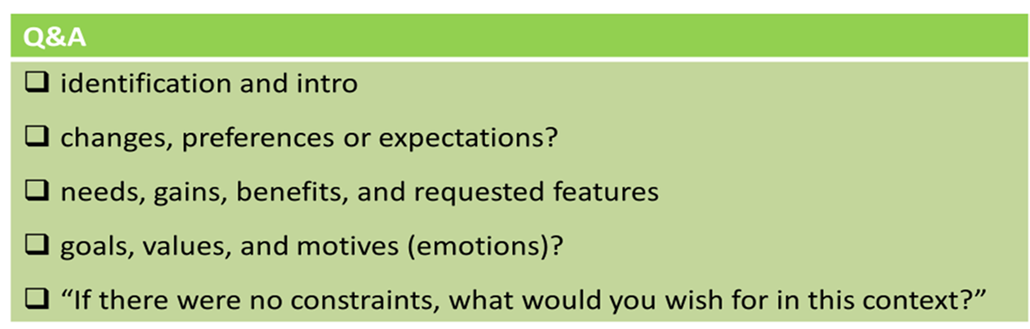
User Persona template
|
Name (insert image) Age Job |
|
||
|
goals |
(S)He sees |
(S)He is afraid of/angry about… |
|
|
(S)He hears |
|
||
|
values |
|
||
|
(S)He thinks |
(S)He is happy about/wishes for… |
|
|
|
motivation |
|
||
|
(S)He says/does |
|
||
4.2.2. Re-defining to understand
Instead of simply trying to understand, the 3i approach to design thinking provides teams with specific tools that re-define and reframe to reach that understanding. Framing and reframing are terms used in this context, where tools are applied in this design thinking stage so that teams can better understand the challenge and the stakeholders together in an integral part of this problem space.
|
Re-defining to understand: |
Tasks and Steps |
|
Concept Maps https://www.lucidchart.com/pages/concept-map https://designthinking.nusselder.org/mapping-concepts-and-themes/
|
1. Begin by reflecting on your current understanding of the idea or concept you want to redefine. Consider its core components, assumptions, and limitations. 2. Analyze existing solutions or approaches related to the idea you want to redefine. Identify strengths, weaknesses, and areas for improvement. 3. Explore unconventional or out-of-the-box ideas. 4. Encourage creativity and experimentation without being bound by traditional norms or expectations. Embrace failure as a natural part of the creative process and a valuable source of learning |
|
Data Analysis |
1. Collecting insights requires follow-up in data analysis, whether quantitative or qualitative. 2. Analysis of market trends, competitor performance, or customer feedback can help teams to identify unmet needs or emerging trends. Data from surveys, interviews, and questionnaires can be analyzed to identify patterns and trends. 3. The results of data analysis can (in)validate findings and provide unexpected information or even motivation to refine decisions in the design thinking process, ultimately leading to more effective user-centered solutions 4. Making data visual can make a stronger impact, igniting all of the senses. Take a peek at the subreddit r/dataisbeautiful for inspiration. |
|
The 5 Whys https://www.mindtools.com/ah6mdtg/5-whys-infographic single lane or multiple lane: https://www.mindtools.com/a3mi00v/5-whys Teams might be interested in learning the origin story at Toyota in the 50s at https://buffer.com/resources/5-whys-process/ |
1. Identify the specific problem that needs solving. 2. Ask why the problem occurred so that the team looks deeper into the underlying reasons. Repeat five times. 3. A process flowchart works well to visualize the questions and responses. 4. For each answer you get, ask "why" again. Each "why" question should dig deeper into the previous answer, aiming to uncover the underlying cause of the problem. Asking until the root cause is revealed means that your team will not simply treat the symptoms. 5. Analyze the root cause and brainstorm potential solutions. |
|
Reporter Questions |
1. With your team, simulate the responses to the reporter questions WHO - WHAT - WHERE - WHEN - WHY - HOW about a specific context of the challenge. 2. Remember to consider the HOW variations, HOW OFTEN - HOW MANY - HOW MUCH - HOW LONG, etc. 3. The responses may open new perspectives that re-define the user’s difficulties so that you can better understand the challenge. |
|
JTBD framework |
1. The Job-to-be-done framework and design thinkers see the user as having multiple dimensions: ➢ functional ➢ emotional ➢ social (or symbolic) 2. Note that, as design thinkers, you could consider the social dimension as symbolic instead. 3. Whichever dimensions you choose to consider, ask questions from the user’s perspective. Can you find the root of the problem this way? |
|
The KNW protocol (see template below) |
1. The KNW protocol announces exploration of three questions to focus and organize your information so that you can continue to discover more. ➢ What do you KNOW about the user? ➢ What do you still NEED to know? ➢ What else do you WANT to know? 2. You can also apply these questions to the overall problem space to be sure you are considering everything that impacts the user. 3. Other KNW protocol applications with How do we as___________ (your role) ideation do/create/design etc._______(major tasks) so that _________(purpose of project)? 4. This can be applied to examine and organized… ➢ logistical concerns, like due dates and benchmarks ➢ background knowledge and skills, like content knowledge and/or how to do something ➢ synthesis, where you might require a lot of pieces of information to answer a given question |
|
HMW questions (see template below) |
1. HMW questions are useful because you re-define three essential elements: ➢ the intended action ➢ the primary user ➢ the desired effect 2. The How might we…? question is asked in a way that invites a variety of possible solutions, not just one particular solution. 3. Reformulate the problem or challenge as an open-ended How might we…? question that invites creative thinking and solution generation. The HMW question should be broad enough to encourage divergent thinking but focused enough to provide a clear direction for ideation and to inspire curiosity and creativity 4. Encourage diverse perspectives and contributions to ensure that the question reflects a comprehensive understanding of the problem and aligns with the goals. |
|
The Re-frame Template (see template below) |
1. This template promotes discussion and reflection and can help you visualize how to re-define your understanding by contrasting your perceptions as follows: ➢ Find a reason that supports the core belief of the current state. Add another supporting belief. ➢ Then write succinctly why you believe this orthodoxy, then add a second reason why you believe it and which action reinforces the orthodoxy. ➢ Contrast with a grammatically opposite reason AND an extremely opposite belief. ➢ Then write succinctly any belief that opposes the orthodoxy and an opposing action that would NOT support the current state. Finally, add yet another opposing action. |
|
SCAMPER Scamper: How to Use the Best Ideation Methods, IxDF https://www.interaction-design.org/literature/article/learn-how-to-use-the-best-ideation-methods-scamper |
1. SCAMPER is the acronym that sparks ideas by changing your lens. 2. These are the seven provoking verbs, indicating actions you should imagine in conjunction with your existing product, service, or plan: Substitute Combine Adapt Modify (sizes like magnification and minimizing) Put to another use Eliminate Rearrange |
|
Value Mapping Stakeholder Maps Made Simple October 6, 2020 The Business Analysis Doctor, https://thebadoc.com/ba-techniques/f/stakeholder-maps-made-simple
|
1. Value Mapping gives you the opportunity to visually consider the value to each stakeholder of a specific topic or challenge in a Value Network Map. 2. The more you understand the stakeholders involved, the better your mapping will be. You are looking for the value exchange for each stakeholder. 3. Map the engagement required for each stakeholder based on your appreciation of their influence. 4. Your analysis can even reveal how you might want to encourage stakeholders to work together, for example, towards a common goal. 5. You can also discover how to increase positive outcomes and avoid negative stakeholder reactions to challenges. |
Some original SEED templates for re-defining to understand with design thinking
The Re-frame Template
|
REFLECTING ON THE CURRENT STATE |
RE-FRAMING FOR A NEW PERSPECTIVE |
|
1. Find a reason that supports the core belief of the current state.
2. Why do you believe this orthodoxy?
3. Can you find another reason to believe it?
4. Which action reinforces the belief?
|
|
The KNW protocol
|
➢ What do we know about the user? |
|
|
➢ What do we need to know about her? |
|
|
➢ What do we want to know about her? |
|
The other KNW protocol
|
➢ What do we know? |
|
|
➢ What is new? |
|
|
➢ What is wild? |
|
How might we…? Questions
How might we help 👤 [*]
to meet her [challenge]
within her [specific context]?
* description of the pertinent aspects of the persona
4.2.3. Ideating
Ideating will once again immerse the teams in the design thinking step of divergence, where quantity is essential. Note however that to ease the team into the following step of prototyping, convergence activities like affinity mapping, clustering, and dot-voting are included at the end of these tasks and tools for ideating.
Note that it is essential that all team members have a clear understanding of the problem and its context before proceeding to ideation. Just as in empathizing, encourage teams to generate as many ideas as possible, without judgment or criticism.
As the teacher, you will want to encourage teams to take risks, explore new perspectives, and embrace failure as a natural part of the creative process. Create a safe space where mistakes are viewed as learning opportunities rather than setbacks.
Remember to reinforce the alternation between divergent thinking (generating a wide range of ideas) and convergent thinking (narrowing down and refining ideas) to explore different possibilities and refine promising concepts.
|
Ideating: Tools |
Tasks and Steps |
|
A collection of tools at Creating Minds: |
“The best way to have a good idea is to have a lot of ideas.” - Linus Pauling, two-time Nobel Prize winning scientist
|
|
Brain Drain |
1. In this guided form of brainstorming, the team focuses on their How might we…? question, while each member works individually, quickly, and silently to generate ten new ideas that respond to the question. 2. Each idea should be separate, so that they can be moved around later. Sticky notes can be helpful but pieces of paper on a table can also work and are more readily recycled. 3. Remember to apply the SEED guidelines for divergence. |
|
Brainwriting Bruchatz, Christian, Robert Fischer, and Janine Stelzer, A Workbook for Academics and Researchers in Higher Education, p. 47. |
1. In a faster and more efficient version of brainstorming, like the Brain Drain, for Brainwriting each team member works separately and in silence. Note that this allows the introverts on the team to participate equally. 2. All the members of the team should participate in the writing circle to diversify the results. Papers will circulate clockwise. 3. You begin by choosing just ONE idea to write at the top of your paper. Then pass your paper to the next person in the circle and receive another with your neighbor’s idea. Read for inspiration and write down your next idea, adapted to your neighbor’s idea. This process is repeated until each participant has contributed to the development of each original idea. 4. Post all of the papers visibly for analysis to select the best ideas. |
|
How would [person or organization] solve it? |
1. Using these prompts and working individually, add three new ideas: • How would Ursula von der Leyen solve it? • How would Cristiano Ronaldo solve it? • How would your mom/dad/grandmother solve it? 2. Quickly use dot-voting to select out the helpful ideas that you would like to prototype. |
|
Yes, and... |
1. Build on ideas with “Yes, and” ideation 2. Work individually to attach a separate comment in the “Yes, and...” format to each existing idea 3. Note that by forcing yourself to say yes to each idea, you could be contemplating the impossible, which could lead to a lot of fun. Enjoy! |
|
Kill your Idea Bruchatz, Christian, Robert Fischer, and Janine Stelzer, A Workbook for Academics and Researchers in Higher Education, p. 50-53 |
1. In true design thinking mode, the team should be eager to expose weak points of their idea(s). This practice will lead to frequent (re-)iteration and opportunities for improvement. Killing your idea works first on the constraints for desirability, feasibility, and viability from two different perspectives: the best AND the worst case scenario. 2. For the best case scenario: ➢ What must happen so that the users are satisfied? ➢ What must happen so that our idea becomes a full success? ➢ What must happen so that everyone wants to use our idea? 3. For the worst case scenario: ➢ What must happen so that the users complain? ➢ What must happen so that our idea fails? ➢ What must happen so that no one wants to use our idea anymore? 4. Confronting these two perspectives will reveal the gaps that the team may have not yet perceived! A final approach really aims at total destruction and some find it the most exciting because these questions together make a potent tool. ➢ Who are potential opponents? ➢ Our idea falls apart when our opponent manages to... ➢ What is our strategy, when this scenario occurs? ➢ Then our idea is worth nothing, because... 5. Work only on the ideas you fail to kill. |
|
Matrix Scale Bruchatz, Christian, Robert Fischer, and Janine Stelzer, A Workbook for Academics and Researchers in Higher Education, p. 58 |
1. To help you rank your ideas, the team must first rank the importance of each of these criteria for their idea: ➢ Desirability: the level of consumer acceptance and engagement with the idea. ➢ Alignment: how well the idea aligns with the organization's core concept or values. ➢ Competency: the idea/product's competitiveness on the market. ➢ Cost: the financial investment needed to adopt the new idea. ➢ Viability: the practical applicability of the idea in real-life scenarios. 2. Then the fun begins as the team decides on a sliding scale that considers their idea base on three (3) characteristics: ➢ User Value from a flea/midge bite to a shark attack ➢ Scalability from Robinson Crusoe to climate change ➢ Feasibility from hammer and nail to the jet engine 3. The team can personalize the sliding scale, include other criteria, or even divide them or split up the criteria. The top three ideas based on this ranking activity should be candidates for prototyping. |
|
Send a Text Bruchatz, Christian, Robert Fischer, and Janine Stelzer, A Workbook for Academics and Researchers in Higher Education, p. 60-61 |
1. Originally called Send a Postcard, this is now moving on from snail mail. The point is to be succinct and clear so that someone who knows absolutely nothing about the project will feel enlightened. Originally this was to be sent to your grandmother. We do not want to imply that grandmothers are less in-the-know. 2. Avoid specific terminology and describe two parts: 3. Aim for a short message without too many details 4. Write the texts individually then bring your drafts together to share, compare, and create ONE final version. |
|
Affinity diagrams for ideation |
1. Gather all the ideas into Affinity Diagrams or Clusters to make sense of your insights from ideation. 2. The groups or themes represented in each cluster should be based on their relationships. 3. Communicate the meaning of each cluster with a relevant title. 4. Examine the results to draw conclusions that will help you decide what to prototype in the next design thinking step. |
|
Dot-Voting |
1. Each person on the team gets three votes, represented by dots or checks 2. Review the team criteria for making your choices. For example, can you use all of your votes on just one idea? Must the three votes be distributed across the board? Which ideas are up for election? 3. One at a time, each person distributes their three votes but the team can opt to look away for increased anonymity. 4. Identify the top choice or new combination of top choices to develop your prototype. 5. As a convenient way to make fast decisions, dot-voting may be used in other moments of convergence. |
4.2.4. Prototyping
Teams will want to explore prototyping, taking advantage of existing skills and learning how to produce representations of solutions in many different ways. Here are just some of the possibilities:
Prototypes come in many formats so teams should be prepared to explore their proposed solutions to find potential problems that still need to be solved.
Encourage teams to create rough prototypes or mockups of their ideas, even if they are simple sketches or diagrams. Prototyping helps make ideas tangible and allows for rapid iteration and testing to gather feedback and refine concepts further.
|
Prototyping: Tools |
Tasks and Steps |
|
Role-playing and scenarios |
1. Define the scenario and the people involved. 2. Assign roles and make time to understand the characterization. 3. Enact the solution in the scenario(s) you are proposing to discover where it can break down. Dramatization will help to expose unforeseen difficulties and barriers. 4. Identify the gaps so that you can re-iterate for that specific problem or even for the entire challenge. |
|
Papercraft, LEGO, Storyboard, Video, Wireframing |
1. Note the many different materials and tools that teams can use to prototype. |
|
Tape and paper clips D.Collective, When You Show a Half-Baked Idea to an Important Client, Medium |
1. Just when your team imagined they had considered everything, find inspiration in this story on prototypes clobbered together from materials at hand |
|
Orientations for prototyping Nusselder, André, and María del Carmen Arau Ribeiro, https://designthinking.nusselder.org/prototyping/ |
1. Prepare an early, inexpensive, and scaled down version of the product. 2. Include different aspects of the prototype related to people, objects, locations, and interactions. When the team understands which aspect you would like to learn more about, this can be highlighted in a rapid prototype. 3. Invite the users and stakeholders to build the prototype as co-designers whenever possible. |
4.2.5. Evaluating
Getting the prototype to the potential users is a revealing moment for concept testing to understand how they feel about the team’s solutions. Even with low-fidelity prototypes, teams can gather important information through this testing stage.
|
Evaluating: Tasks & Tools |
Steps |
|
Hypothesis Testing |
Hypothesis testing involves questions about the Desirability - Feasibility - Viability tryptic. 1. To test market risk (desirability), ask: ➢ Do customers want this solution/product/service? ➢ Define sample size. 2. To test infrastructure risk (feasibility), ask: ➢ Can we build it? ➢ Does the tech exist? 3. To test financial risk (viability), ask: ➢ Does the business model exist? ➢ Can we generate enough revenue? Will it make money? |
|
Setting the stage for testing, |
After establishing the WHAT, WHY, and HOW, consider the responses to these questions: –Who will test your prototype? –What exactly are you testing for? –Where will you be testing? Note especially the questions you will want to explore with the stakeholders: ➢ What resonates with you? ➢ What surprises you? ➢ What do you think is missing?
|
|
Storyboarding https://devsquad.com/blog/storyboards-design-thinking
http://creatingminds.org/tools/storyboarding.htm
|
1. The storyboard you create, with the following six (6) sketches, can test your hypothesis visually. ➢ customer ➢ insight ➢ problem definition ➢ value proposition ➢ how it works ➢ competitive context 2. Carefully re-enact your proposals and observe the interaction of each sketch. |
|
Test Cards (see template below) |
1. Test your hypothesis by completing the following prompts for (1) your hypothesis, (2) testing method(s) and (3) metrics, and (4) criteria: ➢ We believe that (1). ➢ To verify that, we will (2) and measure (3). ➢ We are right if (4). 2. For each test card, include a name for the test, the duration, and the deadline as well as the team member the test card has been assigned to. |
|
Test Grid planning (see template below) |
Use one quadrant for each question: ➢ What was bad? ➢ What was good? ➢ Did you discover any new problems? ➢ Did you discover any new ideas? |
|
A/B testing |
A/B testing is over a century old but in an online context, it is now easier to reach users to discover responses to questions like “What is most likely to make people click/buy our product/register with our site?” For this simple form of a randomized controlled experiment, assign different versions of a product or site to two randomly determined sets of users. The objective is to determine which version influences your success metric. Avoid these common mistakes: ➢ Do not react early to data. Instead, conclude the test and only then, consider the data. ➢ Do not get distracted by too many metrics. Instead, focus on the most relevant metrics. ➢ Do not react to false positive results. Instead, do enough re-testing to be sure. |
Some original SEED templates for re-defining to understand with design thinking
Test Grid planning template
|
Test Grid planning |
|
|
What was bad? |
What was good? |
|
New problems? |
New ideas? |
Hypothesis Test Card template
|
Test Card |
|
|
➢ We believe that...
|
(1) |
|
➢ To verify that, we will... ➢ and measure .... |
(2) (3) |
|
➢ We are right if… |
(4)
|
4.2.6. Implementing
You may have noticed that some design thinking models have fewer steps but experience has taught that, without testing and implementation, the design thinking approach is incomplete. In an ideal situation, implementation will be trouble-free due to careful testing in the previous step.
|
Implementing: Tasks & Tools |
Steps |
|
Check your design thinking in the previous steps, https://mitsloan.mit.edu/ideas-made-to-matter/design-thinking-explained |
1. Note that “Implementation involves detailed design, training, tooling, and ramping up. It is a huge amount of effort, so get it right before you expend that effort.” - Steve Eppinger, MIT Sloan professor |
|
Implementation Plan Checklist Asana, https://asana.com/templates |
1. Prepare a list of objectives so you can measure progress and performance. 2. Develop a scope statement that defines your goals, deadlines, and project outcomes. 3. Guide the team in managing timelines, delegating tasks, and allocating resources with an outline of deliverables. 4. Stick to a schedule by proposing task deadlines that reinforce project completion. 5. Determine risk assessment so that these risks can be prevented. 6. Promote accountability with a clear chart of team member roles and responsibilities. |
|
SEED Business Model Canvas (BMC) (see template below) |
Your SEED Business Model Canvas (BMC) very specifically integrates people, planet, and profit (the TBL/3BL) into more than the Value Proposition, where you describe the holistic value offered to customers and society. Note that Entrepreneurship for a Sustainable Future has offered hands-on training on integrating the TBL/3BL at each traditional consideration. Here’s where you can make a difference in the SEED BMC: Value Proposition: ➢ Economic Value: How the product/service creates financial value for the customer and the company. ➢ Social Value: The social benefits of the product/service, such as contributing to community development, promoting fair trade, or enhancing customer well-being. ➢ Environmental Value: The environmental benefits, such as using sustainable materials, reducing carbon footprint, or offering eco-friendly products. Customer Segments: Addressing segments that are conscious about sustainability and ethical considerations. Customers who prioritize companies with strong TBL/3BL commitments. Customer Relationships: Building and maintaining relationships through corporate social responsibility (CSR) initiatives and sustainable practices that resonate with customers' values. Channels: Using sustainable distribution methods and eco-friendly packaging to reach customers. Key Activities: Implementing sustainable practices in production, operations, and logistics. Activities that enhance social and environmental well-being. Key Resources: Utilizing renewable resources, sustainable raw materials, and technologies that support the TBL/3BL approach. Key Partnerships: Partnering with suppliers and organizations that adhere to sustainable practices and ethical standards. Cost Structure: Reflecting investments in sustainable materials, ethical labor practices, and environmentally friendly technologies. Balancing cost efficiency with TBL/3BL commitments. Revenue Streams: Generating income from products/services that offer social and environmental benefits, appealing to customers willing to pay a premium for sustainable options. |
|
The SEED Checklist (see template below) |
The successful planning, execution, and growth of a business or project requires that the business is well-informed about its environment, capable of growing efficiently, impactful in its operations, and compliant with necessary regulations and standards. 1. Market analysis involves researching and understanding the dynamics of the market, including customer needs, market size, competition, and market trends so that you can make informed business decisions, identify opportunities, and mitigate risks. Be sure that you can identify target markets and market trends and regularly verify your competitive analysis, customer segmentation, and SWOT analysis. 2. Scaling refers to the process of expanding a business or project to accommodate growth, which can involve increasing production capacity, entering new markets, and/or enhancing operational capabilities so that you can increase revenue and market share while maintaining or improving efficiency. Be sure that you understand the scalability of the business model and your technology, your resource allocation, and your infrastructure. 3. Measuring impact involves assessing the effects and outcomes of your project, initiative, or business activity, both qualitatively and quantitatively, to evaluate the effectiveness and value of interventions, guide decision-making, and demonstrate accountability. The key performance indicators (KPIs), return on investment (ROI), social impact assessments, and outcome evaluation are common methods you can use to measure impact. 4. Regulatory compliance ensures that a company adheres to laws, regulations, guidelines, and specifications relevant to its business operations. Standards refer to established norms and benchmarks within an industry. The multiple goals here are to avoid legal penalties, protect the company’s reputation, ensure quality and safety, and build customer trust, for example, through compliance with data protection regulations (e.g., GDPR), industry-specific standards (e.g., ISO certifications), and adherence to financial reporting standards. |
Original SEED templates for re-defining to understand with design thinking
SEED Business Model Canvas (BMC) template
|
SEED Business Model Canvas PEOPLE • PLANET • PROFIT |
||||
|
Key Partners |
Key Activities |
Value Propositions |
Customer Relations
|
Customer Segments |
|
Key Resources
|
Channels |
|||
|
Cost Structure
|
Revenue Streams |
|||
The SEED checklist for Getting to Market
|
✅ |
The SEED Checklist for Getting to Market |
|
|
Measuring impact ➢ People ➢ Planet ➢ Profit ➢ key performance indicators (KPIs) ➢ return on investment (ROI) ➢ social impact assessments ➢ outcome evaluation |
|
|
Regulatory compliance ➢ laws ➢ regulations ➢ guidelines ➢ specifications |
|
|
Standards ➢ norms ➢ benchmarks |
|
|
Scaling ➢ business model ➢ technology ➢ resource allocation ➢ infrastructure ➢ production capacity ➢ operational capabilities ➢ new markets |
4.3. Collected list of links to previously published tools and orientations
Linked tools for empathizing
- Warming up for Brainstorming, https://lucidspark.com/blog/brainstorming-warm-up-exercises
- Color palette generator, Hubspot.com, https://www.hubspot.com/brand-kit-generator/color-palette-generator
- Free Logo Creator & Brand Identity Design, Hubspot.com, https://www.hubspot.com/brand-kit-generator?hubs_content=www.hubspot.com%2Fbrand-kit-generator%2Fcolor-palette-generator&hubs_content-cta=free%20color%20palette%20generator
- Building a persona, https://designthinking.nusselder.org/persona
- Empathy mapping template, NN Group, https://www.nngroup.com/articles/empathy-mapping/
Linked tools for re-defining to understand
- Concept Maps, https://www.lucidchart.com/pages/concept-map
- Data Analysis, https://www.reddit.com/r/dataisbeautiful/?rdt=49333
- Mapping Concepts and Themes, https://designthinking.nusselder.org/mapping-concepts-and-themes/
- The 5 Whys, https://www.mindtools.com/ah6mdtg/5-whys-infographic
- The 5 Whys, single lane or multiple lane, MindTools, https://www.mindtools.com/a3mi00v/5-whys
- The 5 Whys origin story at Toyota, https://buffer.com/resources/5-whys-process/
- The KNW protocol, Magnify Learning, https://magnifylearningin.org/pbl-resources/
- Scamper: How to Use the Best Ideation Methods, IxDF https://www.interaction-design.org/literature/article/learn-how-to-use-the-best-ideation-methods-scamper
- Stakeholder Maps Made Simple, The Business Analysis Doctor, 6 October 2020, https://thebadoc.com/ba-techniques/f/stakeholder-maps-made-simple
Linked tools for ideating
- Tools for creating ideas, Creating Minds, http://creatingminds.org/tools/tools_ideation.htm
- Bruchatz, Christian, Robert Fischer, and Janine Stelzer, Brainwriting, A Workbook for Academics and Researchers in Higher Education, p. 47
- Bruchatz, Christian, Robert Fischer, and Janine Stelzer, Kill your Idea, A Workbook for Academics and Researchers in Higher Education, pp. 50-53
- Bruchatz, Christian, Robert Fischer, and Janine Stelzer, Matrix Scale, A Workbook for Academics and Researchers in Higher Education, p. 58
- Bruchatz, Christian, Robert Fischer, and Janine Stelzer, Send a Text, A Workbook for Academics and Researchers in Higher Education, pp. 60-61
- Stakeholder Value Network Map, Design Thinkers Academy, designthinkersacademy.com
Linked tools for prototyping
- D.Collective, When You Show a Half-Baked Idea to an Important Client, Medium
- Nusselder, André, and María del Carmen Arau Ribeiro, Orientations for prototyping, https://designthinking.nusselder.org/prototyping/
Linked tools for evaluating
- Setting the stage for testing, https://designthinking.nusselder.org/testing/
- The Test Card, Strategyzer, https://assets-global.website-files.com/647655122de68d8272dce023/65c35cb382aabab323d94285_The%20Test%20Card%20-%202023.pdf
- Storyboards & Design Thinking, Devsquad, https://devsquad.com/blog/storyboards-design-thinking
- Storyboarding, CreatingMinds, http://creatingminds.org/tools/storyboarding.htm
- Gallo, Amy, A Refresher on A/B Testing, HBR: Harvard Business Review, 29 June 2017, https://hbr.org/2017/06/a-refresher-on-ab-testing
Linked tools for implementation
- Design Thinking, Explained, https://mitsloan.mit.edu/ideas-made-to-matter/design-thinking-explained
- Implementation Plan Checklist, Asana, https://asana.com/templates
- Process, https://www.process.st/how-to/asana-checklist/
5. SEED Case Studies
The following ten selected SEED case studies showcase the implementation of design thinking in the world of business and beyond. By including these studies in the SEED Guide in your teaching, your students will acquire the basis for recognizing the value of a human-centered design process. In creating a better user experience, the center of diverse global and local efforts is shown to involve both empathy and innovation.
The SEED case studies are formulated for ease-of-reference so that the results of design thinking are clearly communicated yet still offer room for discussion and debate. The six design thinking steps described in these case studies mirror the activities in the SEED Sustainability Challenges of the SEED course on Entrepreneurship for a Sustainable Future:
Empathizing → Re-defining to Understand → Ideating → Prototyping → Evaluating → Implementing
The following business creations have involved design thinking and, in conjunction with the teaching tips gathered in piloting sessions, have thus been selected, written, and prepared for your interpretation:
5.1. Apple's iPhone
Apple's success with the iPhone is often attributed to its human-centered design approach. By deeply understanding user needs and preferences, Apple revolutionized the smartphone industry, creating a device that seamlessly integrates technology into users' lives.
Empathizing: Apple's design team started by empathizing with users to collect insights regarding the reality that phone users were carrying multiple devices, such as cell phones, music players, and personal digital assistants (PDAs). Note that in the 1990s and 2000s, PDAs were handheld personal computers for sending and receiving email, storing contact information, managing calendars, and handling documents and spreadsheets. To better understand the existing technology at the time, especially about BlackBerry devices, a combination PDA and early smartphone, the eponymous 2023 movie from director Matt Johnson is a reliable source. Apple’s ethnographic studies, interviews, observations, and user motivation analysis revealed behaviors, preferences, and frustrations with their mobile devices, especially regarding their fragmented complexity and the lack of a seamless user experience.
Re-defining to understand: With a clear understanding of users' pain points, the teams re-framed the problem statement to address the identified pain points. The result of this process was the question: How to create a single device that could combine communication, computing, and entertainment in a user-friendly way? By envisioning a single, integrated device that could seamlessly combine communication, computing, and entertainment functions, this re-definition helped focus efforts on designing a revolutionary product that would simplify users' lives and offer unparalleled convenience.
Ideating: Designers, engineers, and product developers collaborated to explore a wide range of design concepts and features that could potentially fulfill the re-defined problem statement. Apple encouraged idea generation among these cross-functional teams through creative brainstorming sessions. Given the emphasis on exploring unconventional solutions to the defined problem that would unveil new conceptual solutions, the ideation phase involved thinking outside the box and exploring unconventional solutions, such as touchscreen interfaces, virtual keyboards, and intuitive user interfaces.
Prototyping: With a multitude of ideas generated during the ideation phase, Apple's design team transitioned to prototyping, a critical step where both physical and digital prototypes were created to bring concepts to life so they could be tested and refined. The iterative process allowed the team to experiment with various iterations of different form factors, interfaces, and features to optimize the design based on user feedback and usability testing.
Evaluating: Apple conducted extensive usability studies, focus groups, and beta testing to gather feedback on the prototypes. Through iteration of this feedback loop, the feedforward led to refinements and improvements, ensuring that the final product would resonate with users.
Implementing: Following iterative design, prototyping, and evaluation cycles, Apple finalized the design of the iPhone and prepared for its implementation. In January 2007, Apple CEO Steve Jobs officially unveiled the iPhone at the Macworld Conference & Expo, showcasing its touchscreen interface and innovative features. The iPhone was subsequently launched on June 29, 2007, marking a milestone in the history of mobile technology and revolutionizing the smartphone industry with its groundbreaking design, intuitive user interface, and seamless integration of hardware and software.
Further reading:
- Pan IIM Consulting Organization (PICO), The Birth of Innovation — The Apple iPhone and Design Thinking, https://www.linkedin.com/pulse/birth-innovation-apple-iphone-design-thinking/, 28 September 2023
- John Semley, BlackBerry Is a Movie that Portrays Tech Dreams Honestly — Finally, https://www.wired.com/story/blackberry-movie-review/, 12 May 2023
Discussion questions related to Apple’s iPhone
- What made the iPhone such a hit? How did Apple understand what people wanted in a phone?
- How did Apple keep making the iPhone better? How did they listen to what users were saying to make things better based on feedback?
- How did Apple balance technological innovation with product accessibility for a broad audience?
- What were the key criteria used to evaluate the effectiveness of Apple prototypes during testing phases?
- How did Apple's ethnographic studies and user motivation analysis contribute to the design and development of the iPhone?
- Does Apple still care about the people's needs? Does the company aim to sustain their triple bottom line of people-planet-profit?
- How did Apple's understanding of user needs and preferences influence the design of the iPhone's hardware and software?
- How did Apple gather insights about user behaviors and frustrations with existing mobile devices during their studies?
- What key factors contributed to Apple's success in revolutionizing the smartphone industry with the iPhone?
- In what ways did Apple's prototyping process contribute to the refinement of the iPhone's design, ultimately leading to its successful launch in 2007?
5.2. Airbnb
As a tech start-up Airbnb began as a simple website where its founders, Brian Chesky and Joe Gebbia, rented out air mattresses in their San Francisco apartment to attendees of a local Silicon Valley conference. Airbnb used design thinking to disrupt the hospitality industry. By empathizing with travelers' desire for unique and authentic experiences, Airbnb created a platform that connects hosts with guests in a user-friendly and intuitive way. Airbnb is considered a role model for “designpreneurship”, where entrepreneurs with backgrounds in design professions work together to start companies. In an environment of digitalization, the three pillars for success of Airbnb have been identified as innovation, persistence, and scalability.
Empathizing: Since they started as hosts, they knew that they needed to get to know the users of their service. First, they carried out empathizing strategies with their guests, asking specifically:
"What do people do when they are traveling?
How can they learn how to get from the airport to their lodging quickly?
How can one recommend their favorite place to eat in the neighborhood?"
As the company grew, the founders decided to live exclusively in Airbnb rentals to better comprehend the challenges both hosts and guests faced in using their platform. This hands-on approach gave them firsthand experience with the pain points users encountered. Among the insights, they found the major problem related to the poor-quality photos of the listings. They realized that people were reluctant to book stays because they could not visualize the properties clearly. To address this issue, Airbnb began offering free professional photography services to its hosts. As a result, bookings increased significantly, demonstrating the power of empathy in driving effective solutions.
Re-defining to understand: With the initial success of implementing the process for hosts to secure high resolution and better-quality images, Airbnb founders dedicated further time to better understand the needs and desires of the guests, who were looking for affordable, easy to access, and unique travel accommodations. Conversations with their customers to understand these needs led to many significant breakthroughs.
Ideating: Listening to the hosts and guests’ comments after using the service has been a source of ideation, where many ideas are generated based on the acquired insights from empathizing and re-defining to understand. To improve Airbnb platform services, the 11 star concept was created, which proposes that Airbnb properties can exceed the traditional five-star rating system commonly used in the hospitality industry. The 11 star concept suggests that hosts can go above and beyond in providing exceptional experiences for their guests, offering amenities, services, and personal touches that elevate the stay to a level beyond what is typically expected.
Prototyping: Airbnb prototyped the 11 star concept by encouraging hosts to provide exceptional experiences and amenities that went beyond what traditional hotels typically offered. They incentivized hosts to innovate and personalize their listings by introducing features such as Superhost status, which recognizes hosts who consistently receive high ratings and provide exceptional hospitality. Beyond the photography services, Airbnb introduced design consultations and educational resources to help hosts improve their listings. By empowering hosts to showcase their creativity and hospitality, Airbnb encouraged the development of unique and memorable experiences that aligned with the concept of 11 star hospitality.
Evaluating: Airbnb's success can also be attributed to constant experimentation and an iterative approach to problem-solving. The company has continuously tested new features and improvements, making small but impactful changes to its platform. For instance, Airbnb discovered that guests were more likely to book a rental if the host had a complete and detailed profile. To encourage hosts to fill out their profiles, the company introduced a progress bar, which nudged hosts to add more information (for more on paternal libertarianism and choice architecture, see the references to Richard H. Thaler, distinguished with the 2018 Nobel for economics. This simple tweak resulted in more comprehensive profiles and improved the overall user experience.
Implementing: Launched in August 2008, Airbnb has grown into a global online marketplace for lodging, offering a wide range of accommodations from apartments and houses to unique properties like castles and treehouses. Through innovative initiatives and support for their hosts, the 11 star concept underscores Airbnb's emphasis on creating unique and memorable experiences for travelers, encouraging hosts to showcase their creativity and hospitality in ways that set their listings apart from traditional accommodations.
Further reading:
- Ben Chu, What is ‘nudge theory’ and why should we care? Explaining Richard Thaler's Nobel economics prize-winning concept: How subtle policy shifts can be in everyone's best interest, 13 January 2018, https://www.independent.co.uk/news/business/analysis-and-features/nudge-theory-richard-thaler-meaning-explanation-what-is-it-nobel-economics-prize-winner-2017-a7990461.html
- Designer Fund, The Future of Design Entrepreneurship, https://www.designerfund.com/blog/future-design-entrepreneurship/, 26 October 2017
- First Round Review, How Design Thinking Transformed Airbnb from a Failing Startup to a Billion Dollar Business, https://review.firstround.com/how-design-thinking-transformed-airbnb-from-failing-startup-to-billion-dollar-business/
- Google Ventures, Welcoming Our Newest Advisor: Katie Dill, Former Design Lead at Airbnb and Lyft, https://www.youtube.com/watch?v=b5sjfnAhasE&ab_channel=GV%28GoogleVentures%29, 12 March 2021
- iGMS, What Is Airbnb Superhost Status and Is It Worth The Effort? https://www.igms.com/airbnb-superhost/#, 10 March 2023
- iGMS, Case studies, https://www.igms.com/category/case-study/#, 10 March 2023
- Kateryna Mayka, Design Thinking Examples: Five Real Stories, https://www.eleken.co/blog-posts/design-thinking-examples-five-real-stories
- Kateryna Mayka, Human-Centered Design Examples for Better User Experience, https://www.eleken.co/blog-posts/human-centered-design-examples-for-better-user-experience
- Strate School of Design Blog, https://strate.in/airbnbs-successful-design-thinking-story/, 27 March 2023
- Richard H. Thaler and Cass R. Sunstein, Nudge (The Final Edition): Improving decisions about health, wealth, and happiness. Yale University Press, 2008/2021
Discussion questions related to Airbnb
- How did Airbnb's founders use their own early hosting experiences to understand what both hosts and guests needed? Can you find more information about their origin story?
- How did the founders’ empathetic approach, particularly through first-hand experiences as guests, contribute to the identification of pain points and the development of innovative solutions?
- What did Airbnb do to solve the problem of low-quality photos in their listings, and how did the solution help boost bookings and improve the experience?
- How did the introduction of the 11-star ranking make Airbnb stand out in the hospitality industry? Describe some examples of how hosts can enhance their listings and provide exceptional hospitality.
- What were some key factors contributing to Airbnb's successful implementation and growth from a small startup to a global online marketplace?
- How did Airbnb leverage principles of what Richard H. Thaler has called paternal libertarianism and choice architecture? Can you ideate other areas where this influential strategy could contribute to greater sustainability in other areas?
- How did Airbnb use continuous experimentation and an interactive approach to improve its platform over time?
- What challenges has Airbnb faced in scaling its platform globally and how have they addressed these challenges?
- How did Airbnb's iterative approach to problem-solving, as seen in their constant experimentation and introduction of features like progress bars for profile completion, contribute to the overall improvement of user experience and platform functionality?
- What pain points can you identify for Airbnb and its competitors in offering greater sustainability in the hospitality industry? What future innovations would you like to see to make Airbnb more sustainable?
5.3. Tesla's Electric Vehicles
Tesla's electric vehicles are a result of applying design thinking to the automotive industry. By re-imagining the traditional car design and focusing on sustainability and performance, Tesla has become a leader in the electric vehicle market, applying methods for identifying opportunities, mitigating risks, and scaling operations.
Empathizing: Tesla starts by empathizing with consumers and understanding their needs, desires, and concerns regarding transportation and sustainability. Tesla also considers broader societal trends, regulatory requirements, and environmental concerns related to transportation and energy consumption. Note that, in 1998, the United States government, under the Clinton Administration and with the automotive industry, and the Northeastern states, had reached an agreement to put cleaner cars on the road leading up to the Clean Air Act. The first of these new cars, called National Low Emission Vehicles (NLEV), were released in New England in the 1999 model year and made available nationwide in 2001. Another idea to limit emissions from the personal vehicle sector in the USA proposed that 10% of newly registered vehicles must be emission-free until 2003. Nevertheless, pressure from the car and oil companies forced the law to be repealed. Martin Eberhard and Marc Tarpenning understood the need for change in vehicle emissions and thus founded Tesla, where Elon Musk became a partner in resolving vehicle emissions.
Re-defining to understand: The problem with gas-powered vehicles is that the minimization of emissions is limited. Re-framing the problem of emissions, the company realized that only a vehicle driven by power produced by sustainable energy could be the solution. So, Tesla defined the main challenge as the need for sustainable transportation solutions that reduce dependence on fossil fuels and mitigate environmental impact, and identified performance, affordability, charging infrastructure, and environmental sustainability as key criteria for success.
Ideating: Tesla aimed to produce a car that represented a real or even better alternative to the gasoline-powered car. But they did not want to be dependent on the government and laws, so imagining ideas that were exciting and out-of-the-ordinary, they came up with a dual proposition that included not only a nation-wide charging network but also electric vehicles with a much-improved range. From a corporate perspective, Tesla hired candidates even when they were new to the industry if they showed special aptitude for solving problems. This hiring strategy aimed to contribute to the generation of new ideas from design and engineering teams working together to reach the best possible compromise. Outsiders of the industry would also tend to avoid overthinking about the presumed principles of car manufacturing. Ideas generated during ideation sessions include electric propulsion systems, battery technologies, lightweight materials, aerodynamic designs, and renewable energy integration. Additionally, the car must be cheap even if the price of the battery was initially much higher than that of an Otto motor, but to get this price mass production was needed. Lastly, Tesla came up with the idea of Over-the-air Updates for cars, a very convenient way for their customers to receive information and installations of new features and even have problems resolved in their cars after the vehicles were sold.
Prototyping: Rapid prototyping techniques, computer simulations, and virtual modeling have allowed Tesla to quickly iterate and refine vehicle designs, optimizing performance, efficiency, and user experience. As a part of their prototyping, Tesla launched their first car, the Tesla Roadster in 2008 to especially demonstrate that a fully electric vehicle can be driven not only in the city but also on the highway. The price of over $100,000 (US) and the range limited to 200 miles were prohibitive factors for most consumers, even those with enough available income to spend on behalf of the environment. Launching the prototype, however, showed that the car could in fact be produced and some premiums were included in sales for the prototype. For example, the first vehicles were sold with unlimited charging at Tesla SuperChargers to give their drivers the possibility to drive for free.
Evaluating: A lot of testing was done by the customers. Tesla listened a lot to their customers and fulfilled a lot of their wishes. Tesla also created a voting system with which customers could rate the developers’ ideas. If an idea was particularly well received by customers, the developer received a bonus. In this way, Tesla was able to encourage its employees to perform at their best.
Implementing: For background on the earlier history of the electric car, the 2006 documentary Who Killed the Electric Car?, directed by Chris Paine, offers a context-rich analysis for better understanding of the stakeholders, from consumers to government and gas companies to the automobile industry.
Further reading:
- Neil Dcruz, Tesla’s Design Thinking Approach: How design thinking worked for Tesla, https://www.mygreatlearning.com/blog/teslas-design-thinking-approach-how-design-thinking-worked-for-tesla/#the-approach-towards-design-thinking-that-worked-for-tesla, 17 June 2022
- Babatunde Olorunfemi, The Innovations Driving Tesla's Success: Disruptions, customer transformation, and entrepreneurial strategies, https://www.qeios.com/read/HA56OH, 08 March 2024
- Pius Wiemers, Design Thinking @ Tesla, https://doi.org/10.32388/HA56OH, 16 April 2024
Discussion questions related to Tesla’s electric vehicles
- How did Tesla understand what consumers wanted in terms of transportation and sustainability, and how did this influence their ideas to designing electric vehicles?
- What specific challenges did Tesla identify in thinking about C02 emissions and sustainable transportation, and how did they address these challenges in their electric vehicle designs.
- What were some of the unconventional ideas generated during Tesla's ideation sessions, and how did they contribute to the development of electric vehicles?
- How did Tesla listen to customer feedback and incorporate it into their product development process in a voting system for developers' ideas?
- Is an electric vehicle a good investment in the long term?
- Can the batteries be recycled and where can they be recycled?
- How did Tesla redefine the problem of emissions in the automotive industry and what were the key criteria they identified for success?
- How did Tesla encourage innovation hiring and idea generation within its design and engineering teams?
- How did Tesla's approach to rapid prototyping and iterative design contribute to the evolution of their electric vehicle offerings, particularly in terms of enhancing performance, range, and user experience?
- How did Tesla prioritize sustainability and address concerns regarding CO2 emissions in the automotive industry through their electric vehicle designs, and what strategies did they employ to overcome challenges associated with sustainable transportation?
5.4. IDEO's Work with the Mayo Clinic
IDEO, a renowned design consultancy, is actively working with Design Thinking methodology with the Mayo Clinic to improve the patient experience in healthcare. The Center for Innovation (CFI) was created by the Mayo Clinic in 2008 as a bridge between design thinking and the practice of medicine, specifically within their own facilities. CFI was imagined as a space where the teams could conduct observations and research interviews with patients, family members, and users. They also planned to work with visualization, modeling, prototyping, and testing of possible solutions for the provision of health services.
Empathizing: To empathize with the users, namely patients, healthcare providers, administrators, and other stakeholders, activities were carried out to reach a deep understanding of their needs, motivations, and experiences. IDEO and the Mayo Clinic conducted interviews, observations, and immersion sessions to empathize with the challenges and opportunities within the healthcare system.
Re-defining to understand: This step involved reframing the challenge to reflect a human-centered perspective that could identify opportunities for innovation in the healthcare services. The Mayo Clinic’s history of innovation in care delivery, starting with the invention of the patient medical record in the early 20th century, demonstrates over a century dedicated to finding ways to improve both patient outcomes and the health care experience.
Ideating and prototyping: Divergent thinking is the key for the fusion of design thinking with the medical practice at the Mayo Clinic. Although the complete process is not publicly available, four concrete examples follow:
i) Redesigning Patient Waiting Areas to improve the experience for patients and their families while waiting for appointments or procedures. The process could aim for more comfortable and engaging spaces that are conducive to relaxation or productive use of time.
ii) Redesigning the appointment scheduling process to make it more convenient and efficient for both patients and healthcare providers. Ideas could improve on user-friendly digital platforms, which are widely spread across the healthcare sector worldwide.
iii) Enhancing Telemedicine platforms for remote consultations would involve improving the user interface, integrating virtual waiting rooms, and ensuring seamless communication amongst patients and healthcare providers.
iv) Improving Patient Education Materials would mean making this literature more engaging, accessible, and culturally sensitive.
Evaluating and Implementing: The Center for Innovation at the Mayo Clinic has implemented a structured approach to prototype solutions and turns them into more refined products through a very specific protocol that develops potential solutions into more concrete products. This protocol ensures that every idea deemed worthy is being developed to its fullest. Note also that many innovations are small changes, like the refinement or enhancement of an existing medical device or procedure, where the surgeons, doctors, and nurses are impacted directly by the enhanced usability and effectiveness of the instrument.
Further reading:
- Adriano Amaral Caulliraux and Marcelo Jasmim Meiriño, The Design Thinking and the Health Services: The competitive differential through the humanization of patient experience, Brazilian Journal of Operations and Production Management (BJO&PM) 12(2), 322–328, 28 December 2015, https://doi.org/10.14488/BJOPM.2015.v12.n2.a11
- IDEO, https://www.ideo.com/
- Marcos Saavedra Seoane, Success Stories about the Application of Design Thinking in the Health Field, Design Thinking: Design Thinking in Healthcare, Innovation, https://designthinking.gal/en/success-stories-about-the-application-of-design-thinking-in-the-health-field/
Discussion questions related to IDEO’s work with the Mayo Clinic
- If you wanted to follow the collaborative steps to empathize with various stakeholders within the healthcare system, including patients, healthcare providers, and administrators, how would you conduct these activities?
- How did IDEO team up with the Mayo Clinic to make waiting rooms more chill and appointment scheduling less of a hassle?
- What advantages can you identify in this type of collaboration, between a health service provider and a California-based global design and consulting firm known for collaborating with Stanford University to create d.school for design thinking?
- IDEO uses a sequence of slogans on their site. Consider the impact of these actions and how you could incorporate them into your own practice: We build to think. We listen to unlock. We play to discover. We question to create. We inspire to provoke.
- What inspired ideas did they come up with to make telemedicine easier to use for both patients and doctors?
- How did the Mayo Clinic make sure their patient education materials were actually helpful?
- What role do small innovations play in the overall improvement of healthcare services, particularly in terms of usability and effectiveness of medical devices or procedures?
- How have they ensured that the solutions developed through their collaboration are sustainable? What innovative solutions can you imagine to improve the patient experience in healthcare? Explore the impact of better waiting rooms, appointment scheduling, telemedicine platforms, and patient education materials.
- How did IDEO and the Mayo Clinic ensure that patient education materials were not only accessible and engaging but also culturally sensitive, and what impact did these materials have on enhancing health literacy and improving patient outcomes?
- Explore how culturally-sensitive patient education materials can contribute to improving health literacy and patient outcomes.
5.5. Nike's Flyknit Shoes
Depending on your age, you may still feel that Nike’s Air Jordans are the top in technology for athletic shoes. Beyond what Nike calls the “colorways” and designs available in Air Jordans, Nike’s more recent Flyknit technology allows for more intricate and detailed customization options, offering lightweight construction, adaptive, and sustainable solutions that enhance performance and comfort. Nike used design thinking to create its Flyknit shoes by involving athletes in the design process. Iteratively prototyping different designs, Nike was able to create a product that meets the specific needs of its users. While Nike incrementally introduced changes in materials and manufacturing for many years, the launch of Flyknit in 2012 was a fundamental breakthrough in sustainable innovation. Designers, programmers, engineers, and athletes joined together at Nike’s Innovation Kitchen to develop a shoe that would meet runners’ demands for a more comfortable, high performing sneaker while simultaneously reducing manufacturing waste.
Empathizing: Nike conducted extensive research to understand the environmental impact of its shoe manufacturing process, including material waste, energy consumption, and carbon emissions. Nike's journey through Design Thinking begins with empathy, focusing on understanding the athletes it serves regarding their preferences for footwear design, comfort, and performance. Nike invests extensively in understanding the needs, aspirations, and challenges of its diverse consumer base. Through athlete interviews, surveys, and observations, Nike learned that these athletes were looking for a more sock-like upper construction of their shoes.
Re-defining to understand: After gaining insights into athletes' experiences, Nike defines its goal. It goes beyond merely producing sports gear; it involves addressing the performance and comfort issues athletes encounter and the development of a more sustainable shoe manufacturing process that reduces waste and environmental impact. Nike recognizes that sporting success isn't just about the athlete but also the gear they use. For that, the process required not only rethinking the design, but the entire process of manufacturing shoes, which required inventing new machinery and software. While sneakers are traditionally made by gluing and stitching multiple pieces of material together, Nike developed a method to use one continuous thread woven into a lightweight shoe that would allow for more breathability and support and adapt to a foot in motion. Key criteria for success included reducing material waste, lowering energy consumption, and maintaining or improving product performance and comfort.
Ideating: Ideation is the aim of Nike’s multidisciplinary team of designers, engineers, materials scientists, and sustainability experts. For creative and innovative athletic gear, they brainstorm innovative solutions that combine performance with style. They create cushioned running shoes and incorporate moisture-wicking fabrics in their commitment to pushing the boundaries of athletic wear. Imaginative and inventive designs from Nike include using advanced knitting technology to create a seamless upper for shoes, reducing material waste, and streamlining the manufacturing process. For example, the lightweight construction comes from knitting yarns that together form a seamless, sock-like upper using a precise engineering process. This construction significantly reduces the overall weight of the shoe compared to the traditional cut-and-sew method and the materials used in Air Jordans. Ideas for reducing waste during production are largely related to constructing the upper to exact specifications required for each shoe size, which contrasts with used in manufacturing Air Jordans. In addition to sustainability ideation, other ideas generated for Flyknit-inspired sales include limited-edition releases in collaboration with athletes and artists, exploring the possibilities offered by customization and personalization through variations in color, pattern, and structure within the knit upper.
Prototyping: Nike moved into the prototyping phase using the new knitting technology, experimenting with different materials, knit patterns, and structures to optimize performance and sustainability. Tangible models of their athletic gear were created to rigorously test their concepts and these prototypes are tested under various conditions to ensure they meet the demands of athletes so that the products not only look good but also perform up to the standards established. Note that Nike spent over 10 years producing nearly 200 prototypes of the shoe. Issues related to stretch, support, and breathability within the upper material have impacted the prototyping so that the precision fit conforms to the shape of the foot, providing a snug and supportive feel without sacrificing flexibility,
Evaluating: Nike involves real athletes in the testing phase. These selected athletes provide critical feedback on the prototypes, which is used to fine-tune their athletic gear that is inevitably tested again. This iterative process guarantees that the final products meet the performance standards expected by athletes for durability, comfort, flexibility, and performance. In addition, environmental impact assessments are conducted to measure the reduction in material waste and energy consumption compared to traditional manufacturing methods.
Implementing: Nike launched the Flyknit shoe, featuring a seamless knit upper made from recycled polyester yarn, as a groundbreaking sneaker innovation. The revolutionary method of manufacturing enables Nike to create shoes that excel in performance while reducing the number and amount of materials used and cutting waste by a reported 80%. Nike also introduced sustainability initiatives such as the Reuse-A-Shoe program, which collects old athletic shoes for recycling into new products. Nike has saved 3.5 million pounds of waste since Flyknit’s launch and diverted 182 million plastic bottles from landfills by switching to recycled polyester in all Nike Flyknit shoes. Flyknit provides just one example of how Nike is driving profitable growth and reducing risk through sustainable innovation.
Further reading:
- Barath R., Nike's Winning Stride: Design thinking in athletic innovation, https://www.linkedin.com/pulse/nikes-winning-stride-design-thinking-athletic-innovation-barath-r/, 19 October 2023.
- Carly Fink, Nike: Sustainability and Innovation through Flyknit Technology, NYU Stern School of Business, Center for Sustainable Business, https://www.stern.nyu.edu/sites/default/files/assets/documents/Nike_Carly_04.2017%20-%20Copy.pdf, August 2016.
Discussion questions related to Nike’s Flyknit Shoes
- What makes Nike Flyknit different from their Air Jordans?
- What cool ideas did Nike come up with to make their Flyknit shoes more sustainable and better for athletes?
- How can an iterative process like design thinking ensure the development of products that meet athletes' needs and preferences?
- What sustainability initiatives has Nike implemented on the launch of Flyknit shoes, and what impact have these initiatives had on waste reduction and environmental conservation?
- How has the introduction of Flyknit shoes influenced Nike's overall approach to innovation and sustainability in athletic footwear?
- How does Nike involve athletes in the testing phase, and how does their feedback contribute to refining the design and performance of Flyknit shoes?
- How has the Flyknit technology influenced consumer perception and purchasing behavior towards Nike products, and what impact has it had on the company’s profitability and market position?
- How did Nike incorporate athlete feedback into the design process of their Flyknit shoes, particularly in terms of addressing preferences for footwear design, comfort, and performance?
- Evaluating the environmental impact of Nike’s other manufacturing processes, how does Flyknit technology contribute to sustainability and performance improvement in athletic footwear?
- Can you explain how Nike has integrated feedback from athletes into the ideating and evaluating phases of Flyknit shoes?
5.6. Uber
Uber transformed the transportation industry by applying design thinking principles to their ride-hailing app. By focusing on user needs, such as convenience, safety, and transparency, Uber has created a seamless experience for both riders and drivers. Their user-centric design approach, also known as the Double Diamond UX model, where UX means user experience, is central to their design process. In 2017, to start from zero, without the impediment of the existing codebase or the intervening design choices, the company returned to where it had started in 2009.
Empathizing: The first phase of the Double Diamond model is about discovering the problem and understanding user needs by identifying patterns and trends regarding the ride-hailing app. In this phase, Uber’s designers conduct extensive research, collect data, and map user journeys to gain a deep understanding of their needs and pain points. By observing and interviewing both riders and drivers, Uber’s designers identify their behaviors, attitudes, preferences, frustrations, and motivation, which help them to create more effective solutions. To counter the user frustrations, for both riders and drivers, the designers aimed for 99.99% availability, which translates to just one failure per 10,000 runs, one minute of downtime a week, or one cumulative hour of downtime a year for the entire company.
Re-defining to understand: Once user needs are identified, the second phase in the problem space of the double diamond model involves defining the problem. This can involve creating a clear and concise design brief, outlining the user problem and the goals of the product. Uber designers aim to ensure that the problem they are solving is in fact the right problem, which in turn will help the company to create the right solution. The main objective for Uber’s design process thus became how to make it easy for riders to simply push a button and get a ride from Uber drivers to get where they need to go. Specifically, Uber wanted to increase the availability of their core rider experience and allow for radical experimentation within a set of product rails.
Ideating and Prototyping: A broad variety of ideas are generated through creative brainstorming sessions and sketching exercises. Creating multiple design iterations and prototypes, and testing them with users to gather feedback, Uber’s designers use various tools and techniques, such as wireframes, mockups, and interactive prototypes, to refine and improve their solutions. Uber's designers iterate on these prototypes based on feedback from internal stakeholders and user testing sessions. Through rapid prototyping and iteration, they refine and improve their solutions, exploring different concepts and approaches to find the most effective solution. They aimed for ways to build quality features quickly and innovate on top of the rider app without compromising the core experience. To satisfy both needs, Uber designers looked for ways to give the new mobile architecture cross-platform compatibility, where they met the challenges of the divergent approaches to architecture, library design, and analytics for both iOS and Android engineers to work on a unified ground. The prototyping involved practicing a clear organization and separation of business logic, view logic, data flow, and routing.
Evaluating: In this phase, Uber’s designers implement the selected design solution and launch it to the public. They also continue to monitor user responses with A/B testing and analyze user feedback to further refine the product and enhance the user experience. The designers came up with the concept of code isolation, which separates optional code from core code. While core code, which is subject to a stringent review process, must always run for signing up and taking/completing/canceling a trip; in contrast, the optional code can be turned off and reviewed. This makes it possible for Uber engineers to try out new features and automatically turn them off in case they do not work correctly, without interfering with the ride experience.
Implementing: After evaluating the prototypes and selecting the most promising design solutions, Uber's designers move into the implementation phase. To translate the refined prototypes into actual features and functionalities within the ride-hailing app, collaboration with developers, engineers, and other stakeholders ensures that the designs are translated accurately and effectively into the final product. Uber's designers work closely with the development team to address any technical challenges and ensure seamless integration of the new features into the app's existing infrastructure. Additionally, rigorous testing is conducted to identify and resolve any bugs or usability issues before the new features are rolled out to users. Once implemented, continuous monitoring and iteration are essential to gather real-world feedback and make further improvements to the app, ensuring that it continues to meet the evolving needs and expectations of both riders and drivers.
Further reading:
- Michael Gilburne, A First Look at Uber’s New San Francisco HQ: Uber taps SHoP architects to design its new San Francisco headquarter, Architecture + Design, 31 May 2015, https://www.architecturaldigest.com/story/uber-headquarters-san-francisco-shop-architects
- Brian O’Connell, History of Uber: Timeline and facts, TheStreet, 2 January 2020, https://www.thestreet.com/technology/history-of-uber-15028611
- Uber, https://www.uber.com/it/en/about/
- Uber Blog, Inside Mission Bay, https://www.uber.com/blog/inside-mission-bay/
- Yixin Zhu and Vivian Tran, Engineering the Architecture Behind Uber’s New Rider App, https://www.uber.com/en-PT/blog/new-rider-app-architecture/
Discussion questions related to Uber
- How did Uber use design thinking to make their ride-hailing app better for both riders and drivers?
- What cool ideas did Uber come up with to improve their app? Do any of these features also impact the environment, considering the triple bottom line − people-planet-profit?
- Explain the user-centric design approach implicit in the Double Diamond UX model.
- In the re-defining phase, how does Uber ensure that the problem being addressed is the right problem, and what specific goals do they aim to achieve with their product?
- How does Uber collaborate with developers, engineers, and other stakeholders during the implementation phase to create design solutions into actual features in the app?
- Can you explain how Uber implements the concept of code isolation to evaluate and refine new features within their ride-hailing app without disrupting the user experience?
- What strategies does Uber employ during the implementation phase to ensure effective collaboration between designers, developers, engineers, and other stakeholders in translating design solutions into actual features within the app?
- Discover Uber’s Global Headquarters in San Francisco’s Mission Bay neighborhood. Can you identify the sustainable aspects of this architecture and community planning?
- What can you discover about Uber’s competition on the market? How are their user designs similar/different?
- What other collaborations can you imagine for a nuclear physicist, a computational neuroscientist, and a machinery expert? Hint: Experts from these three areas originally worked together to predict arrival times for Uber.
5.7. Netflix
Netflix leveraged design thinking to revolutionize the entertainment industry. By understanding user preferences and viewing habits, Netflix developed personalized recommendation algorithms that keep users engaged and coming back for more. Keep in mind that Netflix's human-centered UX design goes further than digital design itself since it covers the user experience from start to finish.
Empathizing: Starting in 1997, Netflix founder Reed Hastings spent $10 million a year on streaming technology research to better understand the market, the trends, and users. To understand their users' preferences, behaviors, and pain points related to discovering and enjoying content, they analyzed user data, conducted user interviews, and observed how users interacted with the platform to gain insights into their needs and desires, especially the challenges related to content overload and user dissatisfaction with browsing experiences. Rather than appealing to the masses, knowing their users also helped the company understand the value of catering to niches, provoking their target audiences with in-house productions like Black Mirror (starting in 2011) and Stranger Things (from 2016).
Re-defining to understand: After gathering insights from the empathizing phase, Netflix would redefine the problem they are trying to solve. This could involve identifying challenges such as the overwhelming amount of content available, difficulty in finding relevant recommendations, or user dissatisfaction with the browsing experience.
Ideating: In the ideation phase, Netflix brainstorms potential solutions to address the redefined problem. This can involve exploring innovative approaches to content discovery, such as personalized recommendation algorithms, user-driven curation features, or interactive content exploration tools.
Prototyping: Netflix creates prototypes to visualize and test potential solutions developed during the ideation phase. This includes building prototype recommendation algorithms and interfaces to simulate how personalized recommendations would appear to users. Prototyping has allowed Netflix to experiment with different approaches and iterate based on feedback. For example, to understand feasibility, and following up on the results of a series of Streaming Tests, this feature was included in the DVD subscription, permitting users to become accustomed to streaming itself and gathering recommendations for further change.
Evaluating: In the evaluation phase, Netflix gathers feedback on the prototypes from users and stakeholders to validate the effectiveness of the personalized recommendation algorithms in delivering relevant content recommendations. Conducting A/B testing, user surveys, and data analysis, the teams can assess the impact of the prototypes on user engagement and satisfaction. By 2010, after more than a decade of experimentation and in keeping with their four pillars: think big — start small — fail quickly — scale fast, Netflix was prepared to destroy their DVD delivery service and their early attempts at streaming
Implementing: Finally, Netflix moves forward with implementing the personalized recommendation algorithms based on the feedback received during the evaluation phase. This involves integrating the algorithms into the Netflix platform, optimizing them for scalability and performance, and rolling out the feature to users. Implementation also includes ongoing monitoring and refinement based on user feedback and usage data.
This process demonstrates how Netflix has leveraged design thinking principles to develop personalized recommendation algorithms that enhance the user experience and drive engagement on the platform. The Forbes’ review of Netflix’s innovation process by Chunka Mui, a futurist and innovation advisor who also publishes in the Harvard Business Review, the MIT Technology Review, and the Future Perfect Newsletter via LinkedIn, can serve as a portal to finding other writing by this author and his co-authors Peter B. Carroll and Tim Andrews.
Further reading:
- Design PlayStore, Netflix and Design Thinking: How Netflix innovates and wins using design thinking, https://designplaystore.substack.com/p/netflix-and-design-thinking, 08 May 2021
- Harvard Business Review, https://hbr.org/
- Solène Juteau. Netflix: Disrupting the entertainment market with digital technologies, time and again. Journal of Information Technology Teaching Cases, In press, ff10.1177/20438869231226394ff. ffhal-04374918 https://hal.science/hal-04374918v1/file/Netflix%20author%20JITTC.pdf
- Kateryna Mayka, Design Thinking Examples: Five Real Stories, https://www.eleken.co/blog-posts/design-thinking-examples-five-real-stories
- MIT Technology Review, https://www.technologyreview.com/
- Chunka Mui, Paul B. Carroll, and Tim Andrews, A Brief History of a Perfect Future: Inventing the world we can proudly leave our kids by 2050, Future Histories Press, 2021.
- Chunka Mui, How Netflix innovates and Wins, Forbes, https://www.forbes.com/sites/chunkamui/2011/03/17/how-netflix-innovates-and-wins/, 17 May 2011
- Chunka Mui, Future Perfect Newsletter, LinkedIn, https://www.linkedin.com/newsletters/future-perfect-6903719954911150080/
- Bill Snyder, Stanford Business, Netflix Founder Reed Hastings: Make as few decisions as possible, https://www.gsb.stanford.edu/insights/netflix-founder-reed-hastings-make-few-decisions-possible, 03 November 2014
Discussion questions related to Netflix
- How did Netflix use design thinking to figure out what shows and movies their viewers would like?
- How did Netflix initially empathize with their users to gain insights into their preferences, behaviors, and challenges related to content discovery?
- What were some of the challenges Netflix faced when trying to recommend shows to their viewers?
- What role did prototyping play in their experimentation process?
- Consider the impact of user interfaces that do not fully contemplate the user experience. In what areas of activity in your life do you use satisfying interfaces? What makes each case a good experience?
- What evidence can you find that Netflix applied their four pillars − think big, start small, fail quickly, scale fast − during their experimentation with streaming and the implementation of personalized recommendation algorithms?
- How did Netflix implement the personalized recommendation algorithms developed during the design thinking process, and how did they continuously refine these algorithms based on user feedback and usage data?
- How did Netflix leverage design thinking principles to develop personalized recommendation algorithms?
- What is your impression of the enhanced user experience? Do the algos drive engagement on the platform?
- How do other competitors in the entertainment industry promote sustainability and where do you think Netflix ranks in comparison?
5.8. Starbucks' Mobile Ordering App
Starbucks applied design thinking to its mobile ordering app, allowing customers to order and pay for their drinks ahead of time. By understanding the pain points of waiting in line, Starbucks created a solution that enhances the customer experience, increases efficiency, and boosted their sales by $4 billion.
Empathizing: Starbucks began by empathizing with its customers to understand their frustrations and challenges with the traditional in-store ordering process. They observed and listened to customer feedback regarding long wait times and the desire for more convenience.
Re-defining to understand: After gathering insights from customers, Starbucks re-defined the problem statement to focus on improving the ordering experience by reducing wait times and increasing convenience. They sought to understand not just the symptoms of the problem (long lines) but also the underlying needs and desires of their customers, especially since long lines could mean that a customer would simply give-up or drive away due to perceived wait times at the drive-thru window.
Ideating: With a better understanding of the problem, Starbucks engaged in brainstorming sessions to generate innovative ideas for a mobile ordering solution. They encouraged creativity and collaboration among team members to explore various concepts that could address the identified pain points while aligning with Starbucks' brand values. One of the ideas was to drive the app with a loyalty program. By associating the accumulated customer data with AI and machine learning, the automated personalized incentives help the company to push new products and influence consumer habits in what the chief strategy officer of Starbucks has called personalization "the single biggest driver...of improved spend per member."
Prototyping: Starbucks then created prototypes of the mobile ordering app to bring their ideas to life in a tangible form. These prototypes allowed them to test different features and functionalities, such as order customization, payment options, and pickup preferences, before fully developing the app. Specifically, the designers point out that their initial prototype proved how a location-enabled mobile app would improve not only speed but also accuracy in drive-thru pickups.
Evaluating: Starbucks conducted extensive testing and feedback sessions with customers to evaluate the usability and effectiveness of the mobile ordering app prototype. They collected data on user interactions, satisfaction levels, and any issues encountered during the ordering process to identify areas for improvement.
Implementing: Based on the feedback received and insights gained from the evaluation phase, Starbucks made necessary refinements to the app and proceeded with its implementation. Initially launched in specific regions in 2015, the app progressively expanded to new markets, offering a more convenient and streamlined method to order their preferred beverages. Launch Consulting confirms that, with over 30 million users, mobile ordering accounts for over 16% of Starbucks's revenue.
Further reading:
- Launch Case Studies: That order-ahead app you use every week? We did that, https://www.launchconsulting.com/case-studies/starbucks
- Forrester, Build a Generative AI Strategy for B2B Marketing, https://www.forrester.com/bold
- Starbucks taps new chief strategy officer amid growing union tension, Restaurant Dive, 11 April 2022, https://www.restaurantdive.com/news/Starbucks-Frank-Britt-CSO-strategy-Schultz-labor-argument/621877/
Discussion questions related to Starbucks
- How can a quicker experience at the drive-thru or even for an in-store experience help the environment?
- How did Starbucks empathize with its customers to understand their frustrations and challenges with the traditional in-store ordering process?
- What were some of the problems Starbucks wanted to fix with their mobile ordering app to make ordering coffee easier?
- How did Starbucks accumulate customer data and use AI and machine learning to enhance the mobile ordering experience?
- How does the Starbucks ordering experience impact the environment? Can you imagine other practices that could be implemented in other areas that reduce the time while cars are idling?
- How did Starbucks evaluate the usability and effectiveness of their mobile ordering app prototype?
- How did they use feedback to make refinements before implementation?
- What did the company do to address concerns about privacy and security, particularly in relation to customer data and payment information, in the implementation of its mobile app?
- What specific features did they prioritize to enhance the customer experience?
- What were some of the key problems or pain points that Starbucks aimed to address through the development of their mobile ordering app?
5.9. Raia Heritage Initiative: Safeguarding the spirit
The Raia Heritage Initiative (RHI) defends the prestige and valorization of the secular traditions linked to the manifestation of popular culture, notably the capeia arraiana (pronounced /kæp.eɪ.ə ə.raɪ.a.nə/), in Portugal and worldwide. This bullfighting form, a tradition of the central eastern borderland in Sabugal, near Spain, has been officially recognized since 2011 in the Portuguese list of Intangible Cultural Heritage. As a cultural manifestation exclusive to this territory called the raia (pronounced /raɪ.ə/), this intangible cultural heritage constitutes an added value for the region, with significant tourist potential and economic development. By promoting this attraction, the RHI aims to strengthen the bonds of cooperation amongst the regions and even cross-border. In co-creation with the RHI, the Guarda Polytechnic Institute (IPG) coordinated the design thinking team of stakeholders - teachers, students, and representatives of the RHI - to respond to the main questions for this challenge:
How to promote the intangible cultural heritage of the capeia arraiana without losing its identity?
How to preserve the culture and the tradition of the capeia arraiana and promote the territory?
What technologies to use in the identification, safeguarding, and sharing of the intangible culture of the capeia arraiana?
Empathizing: To understand the stakeholders, the team members engaged with community members, cultural experts, historians, and local authorities to gather insights into the significance of the capeia arraiana and its challenges. The team explored the unique elements of this tradition to define its identity and importance to the local community. Having identified the associated cultural value, the team was ready to re-frame the challenges.
Re-defining to understand: After working with activities to understand the challenge from other perspectives, the problem statement of the core challenge was reformulated as:
How might we help the RHI to balance promotion of the capeia arraiana while preserving its authenticity and identity for the community?
In terms of cultural identity, the team determined that key aspects of the capeia arraiana to be safeguarded were, specifically, traditional music, attire, rituals, and community engagement.
Ideating: Brainstorming creative ways to promote the capeia arraiana, the team came up with promotional strategies that respect this heritage, such as cultural festivals, workshops, and educational programs. Ideas were also generated for community engagement, where the local community would be involved in preserving and celebrating the capeia arraiana through participatory events and storytelling. The team also came up with technological solutions, including digital archives, virtual reality (VR) tours, and mobile apps.
Prototyping: A number of prototypes were created. For example, for the technological solutions, digital tools and platforms were prototyped to identify, safeguard, and share the capeia arraiana. The team also prototyped an online repository, featuring videos, audio recordings, and written materials about the capeia arraiana, and developed immersive VR experiences for users to explore the rituals and traditional places where the capeia arraiana takes place. The apps designed provided information about upcoming events, historical context, and interactive features for users to engage with the activity.
Evaluating and Implementing: Community feedback on the prototypes that were implemented within the local community was gathered to evaluate aspects such as usability, effectiveness, and cultural sensitivity. The impact was ascertained to assess how the technology prototypes can best contribute to promoting and preserving the capeia arraiana while maintaining its identity. With the practice of iteration in mind, refining and improving the technological solutions will be based on ongoing feedback on the results to ensure the solutions align with the community’s needs and values.
Further reading:
- João Pedro Almeida, Capeia Arraiana - The Bullfight of the Borderlands, 15 June 2015, https://blog.joaoalmeidaphotography.com/en/capeia-arraiana-the-bullfight-of-the-border-lands/
- Lau Ardelean, Forcados in action at a bloodless bullfight in Turlock, CA, https://www.youtube.com/watch?v=J1gMY6aIsDY&ab_channel=LauArdelean
- Franklim Costa Braga, Narrada no Risco, Capeia Arraiana, 03 May 2024, https://capeiaarraiana.pt/
- Capeias Arraianas, Conta Oficial das Capeias Arraianas, #TradiçãoÚnicaNoMundo, https://www.instagram.com/capeia_arraiana/
- Intangible Cultural Heritage, Browse the Lists of Intangible Cultural Heritage and the Register of good safeguarding practices, UNESCO, https://ich.unesco.org/en/lists?text=&country[]=00179&multinational=3#tabs
- Tulsi Rauniyar, Inside the Exquisite Tibetan Monasteries Salvaged from Climate Change, BBC, 01 May 2024, https://www.bbc.com/future/article/20240429-the-indigenous-community-repairing-tibetan-monasteries-crumbling-due-to-climate-change
- Sabugal Municipality, Capeia Arraiana, https://www.cm-sabugal.pt/en/sabugal-municipality/tourism/capeia-arraiana/ (EN); https://www.cm-sabugal.pt/concelho-do-sabugal/turismo-cultura-lazer/capeia-arraiana/ (PT)
- San Joaquin Valley Portuguese Festival, Carlos Vieira Foundation, https://www.carlosvieirafoundation.org/events/sjvportuguesefestival.html
- Emanuele Siracusa, At the Capeia Arraiana - A tale of horses, bulls and bravery, 20 January 2015, https://blog.emanuelesiracusa.com/2015/01/at-the-capeia-arraiana/
- Adérito Tavares, A Capeia Arraiana. Lisboa, 1985.
Discussion questions related to the Raia Heritage Initiative
- How is the capeia arraiana in this border region of Portugal different from bullfighting in Spain? What happens to the bulls after the event?
- How will the local Raia community dialog with defenders of animal rights? What could be changed in the capeia arraiana so that this cultural activity could be aligned with these concerns?
- How can we maintain tradition while avoiding the suffering and stress of the animals?
- How can cultural anthropology contribute to understanding activity that is different from your own? Can you find any “rites of passage” in your own cultures?
- What expressions of cultural heritage can you identify in your own region? When do they take place?
- On the UNESCO lists of Intangible Cultural Heritage, can you discover other practices that you believe should be safeguarded (or not)?
- Does the importance of cultural heritage warrant safeguarding every tradition? Where do you draw the line?
- Do you attribute equal importance to the tangible and the intangible? For example, as we write, Tulsi Ranyar has published an article with the BBC on the restoration of 14th-century Buddhist monasteries by the local community in the Mustang district of Nepal, where the role of women in society is being re-defined based on this activity.
- What is the place of the triple bottom line – people, planet, profit – in the production of this (and other) cultural event(s)? As you identify the issues related to the capeia arraina, have you considered the advantages and disadvantages for the local community?
- If the capeia arraiana were banned, how would the local community feel/behave? What would they say/do? Create a persona to empathize with this situation.
5.10. NextGen Vocational Education and Training School
While designing the university of the future is a common practice activity for initiates in design thinking, this case study involves improving teaching and learning in a vocational education and training school (VET, also known in Portuguese as a professional school). Considering the needs for learning prior to or even in preparation for university requires understanding the specific challenges of this educational context. As found by a design thinking team in this case study, strategic enhancements can significantly improve the teaching and learning experiences in school, ultimately better preparing students for successful careers in their chosen fields.
Empathizing: The team tried to better understand the key stakeholders by identifying and empathizing with students, school board members, administrators, industry partners, and alumni. They conducted interviews, observations, and surveys to gather insights into the challenges, goals, and aspirations of different stakeholders within the defined context. As they got to know the situation better, the team developed personas to represent different types of learners, teachers, and even the auxiliary staff as well as community members and potential industry collaborators to better define their needs and pain points. Some of the challenges identified were:
Maintaining relevance and innovation in the school curriculum.
Engaging students through interactive and hands-on teaching methods to develop practical and technological skills for professional success in specific fields.
Collaborating with industry partners and maintaining partnerships with industry stakeholders.
Re-defining to understand: To identify the key challenges, the team synthesized the insights gathered during the empathy phase. This examination helped to define the core challenges and opportunities for improvement in the teaching and learning processes. They re-framed the problem in two How might we…? (HMW) questions, developed to encapsulate the main issues:
(HMW1) How might we help the board and administration improve collaboration between academia and industry in their community?
(HMW2) How might we help the students and teachers enhance practical skills development at their school?
Ideating: In this design thinking phase for generating creative solutions, the team brainstormed potential solutions with this diverse group of stakeholders, including administrators, educators, students, and industry partners. They pulled together as a team, encouraged by out-of-the-box thinking, and came up with ideas that leverage technology, experiential learning (ExL, understood as learning through reflection on doing), and interdisciplinary collaboration. Some of the ideas to selected to join industry and academia beyond the classroom for HMW1 were:
1) Implement a systematic process for identification of funding calls (private or public) for enhancing technologically-based ExL, perhaps through an observatory that could help other schools with similar ambitions share and learn from each other.
2) Create a network for Virtual Research Environments and Discussion Forums that bring together representatives of school administrators, industry, teachers, students, and other stakeholders.
3) Define a clear identity for the school within the community and industrial fabric.
4) Co-design with industry and community partners for curriculum revision and reformulation.
Regarding HMW2, further ideas were generated to improve the teaching and learning processes:
5) Design ongoing teacher training programs on how to apply interactive and practical teaching strategies so that students can engage in more ExL opportunities.
6) Co-design case studies with industry professionals who are invited for this purpose.
7) Explore diverse learning processes in a growth mindset.
8) Coordinate the timelines for internships and workshops so that students can apply theoretical knowledge in real-world settings.
9) Develop Virtual Labs as a technologically-based simulation in real-world settings.
Prototyping and evaluating: Before developing their prototypes, the team continued to explore their ideas and came up with a set of target prototypes. They built tangible representations of selected ideas and concepts, including pilot programs, new learning resources, and technology-enabled solutions, such as:
1) Workshops, seminars, and field trips to join youth and teachers with industry professionals in Communities of Practice and Learning to promote green initiatives and practice design, critical, and creative thinking.
2) A rotating semester, blending theory with practical industrial training in class and in short internships to incorporate interactive and practical teaching.
3) Additional internal regulation on (a) the integration of community and industry professionals in the final juries for the evaluation of the students’ final projects and/or internships; (b) an attractive school name − NextGen − to reflect its future-forward stance; and (c) obligatory student and teacher collaborations in community activities that promote well-being and sustainability.
4) A mobility exchange program for teachers from school(s) and professionals from industry.
5) Hiring industry professionals as “specialist teachers” to share the teaching activities.
6) Integrating community stakeholders and industry managers in the NextGen Community Consulting Council.
7) Self-awareness and growth mindset training across the curriculum complemented by weekly interdisciplinary World Cafés, where the students can develop more accountability and greater pride of purpose as future international, national, and community representatives.
The team is iterating quickly so they can test the most promising prototypes in controlled environments within the school, where they are gathering feedback from the stakeholders and making improvements based on these insights. Rolling out their refined prototypes in real-world teaching and learning settings, the teams feel more confidence in monitoring their effectiveness and gathering quantitative and qualitative data on their impact. In collecting the feedback, the team is engaging the stakeholders in ongoing feedback loops, which will serve to assess the usability, relevance, and impact of the solutions to be implemented.
Implementing: An important aspect of implementation is iterating and scaling, where the stakeholders learn to participate in further refinement of the solutions so that they can prepare for broader implementation school-wide and within the community and local industrial fabric. Any new decisions will go through the design thinking approach as they consider scalability and sustainability factors.
Further reading:
- Sidhant Bedi, The pros and cons of Vocational Education Training, 23 November 2023, https://hospitalityinsights.ehl.edu/pros-cons-vocational-education-training
- European Center for the Development of Professional Training, https://www.cedefop.europa.eu/en/publications
- W. Norton Grubb, Vocational Education and Training: Issues for a thematic review, OECD, November 2006, https://www.oecd.org/education/skills-beyond-school/43900508.pdf
- Margarida Morgado, Margarida Coelho, María del Carmen Arau Ribeiro, Alexandra Albuquerque, Manuel Moreira da Silva, Graça Chorão, Suzana Cunha Ana Gonçalves, Ana Isabel Carvalho, Mónica Régio, Sónia Faria and Isabel Chumbo, CLIL Training Guide − Creating a CLIL Learning Community in Higher Education, DeFacto Editores and ReCLes.pt, 2015, https://recles.pt/images/Documentos/CLILTrainingGuide.pdf
- Wenger, Etienne. Communities of practice: Learning, meaning, and identity. Cambridge University Press, 1998. https://doi.org/10.1017/CBO9780511803932
Discussion questions related to the NexGen Vocational School
- What is the relevance of innovation and sustainability in developing teaching practices?
- Some national schooling systems simply do not contemplate vocational education as a transition into higher education. Discuss the advantages and disadvantages of a more practical approach to learning.
- Where can you see this co-design between industry and schools in your own community?
- Does your current university sponsor curricular internships at local or (multi)national firms and organizations? Which stakeholders benefit most from these internships?
- What are the pros and cons of stakeholder involvement? Can you imagine some “unpredictable” or surprising results that could derive from enhanced interaction between the stakeholders?
- How does education fit a business model? Do you see education as a system to protect students from the labor market, in an effort to preclude child labor? Aiming for a sustainable transition to the labor market, why would a close-knit community be beneficial?
- As a budding entrepreneur, why would it be important to get involved in your community at a young age? How can you encourage community involvement at school?
- Consider motivation for each of the stakeholders. For example, how could you help your teachers to feel good about any potential extracurricular activity?
- Redesigning a school brings stakeholders together across multiple generations. Find examples to contradict the saying “You can’t teach an old dog new tricks''.
- Can you ideate more solutions for excellence in learning before you reach university?
6. Selected references
The references for this SEED Guide, notwithstanding the separate references for each case study, have been gathered into the following four categories for further reading to complement your teaching:
- For more ideas on teaching sustainability and autonomous, sustainable learning
- For better team communication and awareness of AI and communication roles
- For design thinking and design for innovation in-person and online
- For understanding learning and learning objectives
For more ideas on teaching sustainability and autonomous, sustainable learning
- Arau Ribeiro, María del Carmen, Aleksandra Sudhershan, Alexia Schemien, Réka Asztalos, and Alexandra Szénich. 2023. “Lighting a sustainable fire for learner responsibility in LSP: A hands-on workshop with tools designed to promote collaborative autonomy”. In Aniko Brandt (Ed.), Quo vadis Sprachlehre: Neue Unterrichtsformen vor der Tür - AKS-Online-Konferenz 2021. Bochum: Technische Universität Darmstadt, pp. 517-526.
- Asztalos, Réka, Agnes Ibolya Pál, Alexia Schemien, Alexandra Szénich, and María del Carmen Arau Ribeiro. 2023. Practical Guidelines for Teachers to the CORALL Project − A Teachers' Guide to Resources for LSP Learner Autonomy. https://view.genial.ly/6380a86cf79a1b0018e8fc0d
- Gulikers, Judith T. M., and Carla Oonk. 2019. “Towards a Rubric for Stimulating and Evaluating Sustainable Learning”, Sustainability 11: 969. https://www.semanticscholar.org/paper/Towards-a-Rubric-for-Stimulating-and-Evaluating-Gulikers-Oonk/e4bf987083a510bbdf6ce0ef58e4909b485dc5c2
- Macagno, Thomas, Anh Nguyen-Quoc, and Suzi P. Jarvis. 2024. "Nurturing Sustainability Changemakers through Transformative Learning Using Design Thinking: Evidence from an Exploratory Qualitative Study". Sustainability 16, no. 3: 1243. https://doi.org/10.3390/su16031243
- Manna, Valerie, Meike Rombach, David Dean, and Hamish G. Rennie 2022. "A Design Thinking Approach to Teaching Sustainability". Journal of Marketing Education 44, no. 3: 362-374. https://doi.org/10.1177/02734753211068865
- Némethová, Íldiko, María del Carmen Arau Ribeiro and Eva Stradiotová. 2022. "Reinforcing the Paradigm Shift to Focus on the Learner in 21-st Century Higher Education". In Silvia Cristina Marginean, Camelia Budac, and Troy B. Wiwczaroski [Eds.), The Paradigm Shift in Higher Education: Experiences in and Considerations of Virtual, Hybrid and Blended Learning, Hamburg, Germany: Verlag Dr. Kovac GmbH, pp. 95-127.
- Steuer-Dankert, Linda. 2023. "Training Future Skills − Sustainability, interculturality & innovation in a digital design thinking format". Proceedings of the 19th International CDIO Conference, NTNU, Norway, pp. 119-130. http://www.cdio.org/knowledge-library/documents/training-future-skills-sustainability-interculturality-innovation
For better team communication and awareness of communication roles
- Arau Ribeiro, María del Carmen, Noel Lopes, Pedro M.S.M. Rodrigues, and Natália Gomes, 2020. "Trabalho interdisciplinar: promover o pensamento criativo [Interdisciplinary Work: Promoting Creative Thinking]“. Revista Egitania Sciencia − Especial Educação, pp. 9-24. https://doi.org/10.46691/es.v0i0
- Barker, Larry L. 1971. Listening Behavior. Englewood Cliffs, New Jersey: Prentice Hall. https://archive.org/details/listeningbehavio0000bark
- Listening styles, Changing Minds, https://changingminds.org/techniques/listening/listening_styles.htm
- Council of Europe. 2020. Common European Framework of Reference For Languages: Learning, Teaching, Assessment, Companion Volume. Strasbourg. https://rm.coe.int/common-european-framework-of-reference-for-languages-learning-teaching/16809ea0d4
- Rust, Roland, and Ming-Hui Huang. 2021. The Feeling Economy: How AI is creating the Era of Empathy. Springer International Publishing.
- Smith, Robert H., The Feeling Economy: How AI is Creating the Era of Empathy, School of Business – New Book Guides Workers, Leaders and Educators, 21 January 2021. https://www.rhsmith.umd.edu/news/feeling-economy-how-ai-creating-era-empathy
- Smith, Robert H., Tech Layoffs Signal ‘Feeling Economy’ Shift, School of Business – Smith Brain Trust, 13 February 2024. https://www.rhsmith.umd.edu/research/tech-layoffs-signal-feeling-economy-shift
- Watson, Kitty W., Larry L. Barker, and James B. Weaver. 1995. Listening Styles Profile. Amsterdam: Pfeiffer & Company. https://www.tandfonline.com/doi/abs/10.1080/10904018.1995.10499138
For design thinking and design for innovation in-person and online
- Arau Ribeiro, María del Carmen, and Robert Fischer. 2021. Chapter 2 − Design Thinking and Digital Organizations. In Salamzadeh, Yashar (Ed.): Digital Transformation: A Human-Centric Approach. Istanbul: Efe Akademi, pp. 25-58. Available at https://books.google.pt/books?id=-h1gEAAAQBAJ&printsec=frontcover#v=onepage&q&f=false
- Arau Ribeiro, María del Carmen, André Nusselder, Nataša Brouwer, Natália Gomes, and Noel Lopes. 2020. "An International Student Workshop on Design Thinking in Time of Corona: Redesigning an international event as an online interactive learning experience." In Lidia Pokrzycka (Ed.), Innovative Teaching Methods: Practical teaching in higher education. Lublin: Maria Curie-Sklodowska University Press, pp. 11-38. Available at https://www.researchgate.net/publication/346785124_Innovative_Teaching_Methods#fullTextFileContent
- Beckman, Sara L., and Michael Barry. 2012. "Teaching students problem framing skills with a storytelling metaphor". International Journal of Engineering Education 28, no. 22: p. 364-373. https://studylib.net/doc/11406151/teaching-students-problem-framing-skills-with-a-storytell...
- Bruchatz, Christian, Robert Fischer, and Janine Stelzer. 2019. Applying Design Thinking: A Workbook for Academics and Researchers in Higher Education. https://tu-dresden.de/ing/maschinenwesen/imm/td/ressourcen/dateien/forschung/eBook_2_0_English.pdf?lang=en
- Dzombak, Rachel, and Sara Beckman. 2020. "Unpacking capabilities underlying design (thinking) process". International Journal of Engineering Education 36, no. 2: 574-585. https://escholarship.org/uc/item/2jr445h8
- Crowe, Byron, Jessica S. Gaulton, Noah Minor, David A Asch, Jeff Eyet, Erin Rainosek, Kristen Flint, Joseph Joo, Chip Chambers, Sherry Bright, Julius J Yang, Gene Beyt, Read Pierce, and James M. Moses. 2022. "To improve quality, leverage design". BMJ Quality & Safety 31, no. 1: 70-74. https://doi.org/10.1136/bmjqs-2021-013605
- Arau Ribeiro, María del Carmen, Natália Gomes, and Noel Lopes. 2020. DT.Uni: Design Thinking Approach for an Interdisciplinary University, https://portal.ipg.pt/DTtasks/
- Arau Ribeiro, María del Carmen, Natália Gomes, and Noel Lopes. 2020. The Design Thinking Learning Model: The 3i Approach to Design Thinking, https://portal.ipg.pt/DTtasks/DTmodel
- Hagen, Jan U. (2022). "Error Culture – Easier Said than Done". Forbes: Leadership strategy. https://www.forbes.com/sites/esmtberlin/2022/10/25/error-culture--easier-said-than-done/
- Kim, Euhnay, Senay Purzer, Carolina Vivas-Valencia, Lindsey Payne, and Nan Kong. 2020, June. "Problem reframing and empathy manifestation in the innovation process". Proceedings of the 2020 ASEE Annual Conference & Exposition, Montréal, Quebec, Canada. https://par.nsf.gov/servlets/purl/10204868
- Lélis, Catarina. 2022. The Impact Plan: Rethinking today, remaking tomorrow, designing a better world. Amsterdam: BIS Publishers. https://www.researchgate.net/publication/364321311_The_Impact_Plan_Rethinking_Today_Remaking_Tomorrow_Designing_a_Better_World_preview_version
- Nusselder, André, and María del Carmen Arau Ribeiro. 2020. Design Thinking for Higher Education, https://designthinking.nusselder.org/methods/
For understanding learning and learning objectives
- Anderson, L. W., D. R. Krathwohl, and B. S. Bloom (2001). A taxonomy for learning, teaching, and assessing: A revision of Bloom's taxonomy of educational objectives. New York, NY: Longman.
- Davis, James R., and Bridget D. Arend. 2012. Facilitating Seven Ways of Learning: A Resource for More Purposeful, Effective, and Enjoyable College Teaching (1st ed.). Routledge. https://doi.org/10.4324/9781003444763
- Fink, L. Dee. 2003. Creating Significant Learning Experiences: An Integrated Approach to Designing College Courses. San Francisco: Jossey-Bass.
- Wiggins, Grant, and Jay McTighe. 2005. Understanding by design (2nd ed.). Alexandria, VA: Association for Supervision and Curriculum Development (ASCD).
7. The SEED consortium and the project results
The international consortium working on SEED: Sustainable Entrepreneurship in EDucation (project nº 2022-1-PL01-KA220-HED-000088765) joins the University of Information Technology and Management in Rzeszów (UITM, Poland), Wirtualis Sp. z o.o (Poland), Reykjavík University Center for Research on Innovation and Entrepreneurship (RUCRIE, Iceland), Kazimieras Simonavičius University (KSU, Lithuania), and Guarda Polytechnic University (IPG, Portugal).
The SEED project coordinators at UITM have developed an online platform to gamify sustainable entrepreneurship for university students with Wirtualis, a private firm offering bespoke web development, innovative e-learning solutions, and immersive business simulations tailored to educational and corporate needs. Simultaneous materials development that incorporates a design thinking toolkit of strategies and techniques is the collaboration of RUCRIE − creating the ten-week course on Entrepreneurship for a Sustainable Future, IPG − building the companion SEED Guide, Using Design Thinking for Sustainability Challenges, and KSU − transforming these components into digital content.
The collection of materials is available as open educational resources (OER) for any teachers interested in a design thinking approach to sustainability and entrepreneurship.
SEED project team members
UITM (project coordinators) − Justyna Żyła and Joanna Swiętoniowsk (coordinators), Grzegorz Karpiuk, Ewelina Woźniak
IPG − María del Carmen Arau Ribeiro and Fernando Marcos (co-coordinators), Natália Gomes, Noel Lopes, Paula Coutinho, Clara Silveira, and Cristina de Castro
RUCRIE − Marina Candi (coordinator) and Elfa Frið Haraldsdóttir Roum
KSU − Reda Juodkūnienė (coordinator), Deimantė Žilinskienė, Gabija Gudelevičiūtė, Toma Jakutytė and Agnė Bružaitė
Wirtualis Sp. z o.o − Bart Szymański
SEED: Sustainable Entrepreneurship in EDucation
(project nº 2022-1-PL01-KA220-HED-000088765)