
SEED Guide

Using Design Thinking
to Solve Sustainability Challenges
1.3. Design Thinking Approach
A Design Thinking process usually starts with a challenge, which gives focus and direction. We are working with six different interconnected phases of the process.
Become familiar with the six phases in each challenge that follow the 3i Approach to Design Thinking, where interdisciplinary teams engage in innovation through (re)iteration, in a design thinking model designed under the coordination of the Guarda Polytechnic University (IPG, from the Portuguese Instituto Politécnico da Guarda) partner team for the Erasmus+ project DT.Uni: Design Thinking Approach for an Interdisciplinary University (2017-2020, nº 2017-1-PL01-KA203-038527).
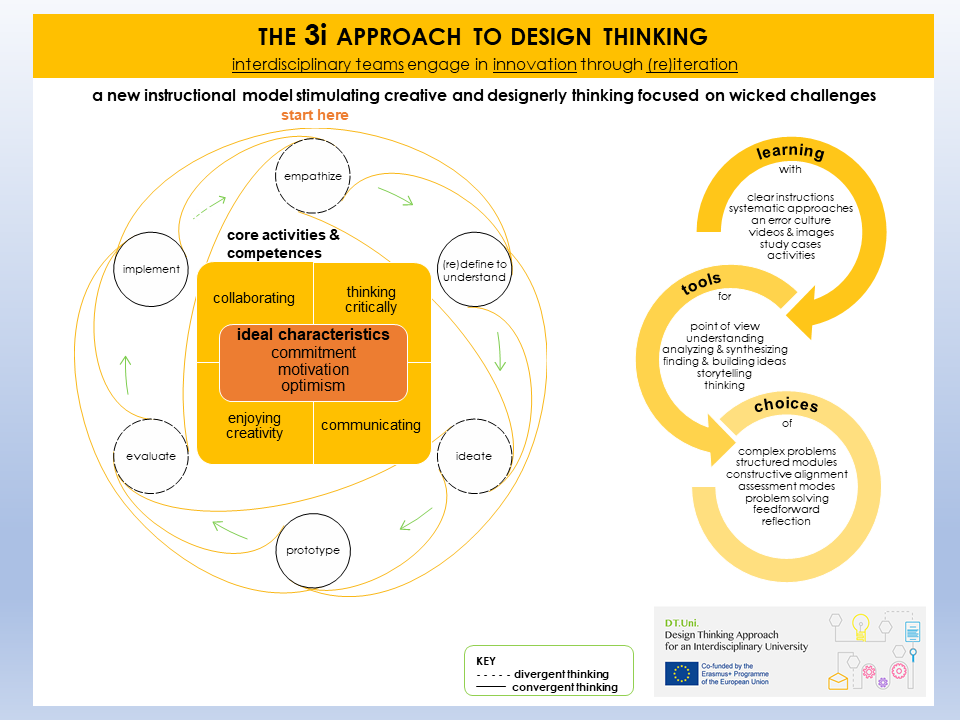
Source: https://portal.ipg.pt/DTtasks/DTmodel
The 3i approach reinforces your own awareness that, when possible, engaging students from different areas of study can broaden the representation of perspectives, which in turn enriches learning with more challenging interaction. The innovation target of design thinking meets the specific purposes of innovating in existing businesses or creating new businesses in this SEED course on Entrepreneurship for a Sustainable Future. Finally, the (re-)iteration at the heart of the 3i approach reinforces the “fail fast” ethos of a successful error culture (Arau Ribeiro and Fisher 2021), where mistakes are an opportunity to improve and learn rather than a reason for punishment. Note that “an open error culture is a crucial building block for reducing project failures and serious errors and for increasing organizational success” (Hagen 2022).
The ideal characteristics of commitment, motivation, and optimism are allied to the core activities and competences promoted through this SEED course on Entrepreneurship for a Sustainable Future; as the teacher, you will want to assure that your students are enjoying creativity, thinking critically, communicating, and collaborating on teams.
The construction of a learning environment that includes diverse materials, clear instructions, and systematic approaches in a successful error culture will adjust to find the right blend of tools for expressing points of view, understanding, analyzing and synthesizing, finding and building ideas, storytelling, and thinking. The learning environment and tools will be accompanied by choices that teachers and students make together regarding the complex problems, structured modules, constructive alignment, assessment modes, problem solving, feedforward, and reflection. The six steps include the (re)iterative DT activities of empathizing, (re)defining to understand, ideating, prototyping, evaluating, and implementing. Each DT step is supported by the suggested tasks and tools and a step-by-step description to help you as you help your students (see section 4.2).
The first phase of empathizing requires teams to explore, collect insights and understand the problem they intend to solve, and to get to know the users who will benefit from that solution. A user-centric perspective, namely by using tools like Persona development and other empathizing tools, helps to understand how users feel and effectively identifies their motivations and needs (Bruchatz, Fischer, and Stelzerref 2019; Manna, Rombach, Dean, and Rennie 2022).
Potential solutions to the identified problems are planned in the ideating phase dedicated to creation. In addition to formulating hypotheses about problems to be solved, you also conceptualize and organize them through more interviews, brainstorming, and brainwriting as well as tools like Kill your Idea, the Matrix Scale, and Send a Text. Ideation tools like brainstorming encourage full team participation, generating and collecting many new ideas without the threat of judgment or dismissal of ideas. When the team has generated as many potential solutions as possible, then these possibilities are organized, evaluated, and selected for their suitability through dot-voting. Two important results become apparent at this stage: Teams have a solid understanding of the users’ problems and needs. The teams will have also created a user-centric problem statement using tools, like the How might we…? question.
Then, by creating actual prototypes to implement the teams’ hypothetical solutions, their creativity is critically explored before advancing to the evaluation phase reserved for testing the prototype and, when possible, validating it with potential or even simulated users. Since solutions can be rejected, accepted, and/or improved, evaluating is also the starting point for changes, leading to a new iteration and beginning the process anew to improve and/or to redevelop ideas.
In the SEED Guide, links are provided to online tools for ease of reproduction. In general, we recommend the design thinking approaches and templates published by Bruchatz, Fischer, and Stelzer (2019: 85-109) and Nusselder and Arau Ribeiro (2020). The templates in these publications, respectively coordinated by the Center for Synergy Enhancement, Technische Universität Dresden (TUD) and from a joint UvA-IPG production (University of Amsterdam and Guarda Polytechnic University), were tested and refined in pilot courses and student and teacher training workshops of the DT.Uni Erasmus+ project (2017-2020) to provide clear and easily reproducible tools that gather and analyze information at each step in the challenges. As a project that concluded during the Covid-19 confinement, the consortium of eight universities in eight countries rose to the challenges of emergency remote teaching and, thus, managed to pilot test the Open Educational Resources (OER) in online and in-person teaching modes. Note that, rather than printing out visualization tools, you may prefer to engage students by giving them the opportunity to draw out and develop their own visual representations on paper to learn more about each given tool and its purpose(s).
We also highly recommend reviewing the following:
- how to better understand design thinking through the lens of experiential learning (ExL) theory (Dzomback and Beckman 2020)
- the interplay in the innovation process between problem framing and empathy manifestation (Kim et al. 2020)
- problem framing and developing the related essential skills of empathy, insight recognition, thinking divergently, and learning through failure (Beckman and Barry 2012)
- quality improvement through design thinking (Crowe et al. 2022)