
SEED Guide

Using Design Thinking
to Solve Sustainability Challenges
2. Matching teaching to the proposed SEED learning outcomes
The comprehensive set of learning outcomes aims to align with the dynamic nature of entrepreneurship and prepares students to navigate and thrive in a competitive business environment. Working with a design thinking approach, students will practice and learn to wield a wide range of creative and critical skills and knowledge areas, providing a well-rounded foundation for aspiring entrepreneurs. The objectives cover the importance of social responsibility, integration of well-being initiatives, innovation, research and development (R&D), and market analysis — all essential components of successful sustainable business ventures. The proposed learning outcomes for the SEED course on Entrepreneurship for a Sustainable Future, created in collaboration with university students, are as follows:
- Recognize and adapt to emerging technologies and industry trends by creating innovative and sustainable opportunities through design thinking activities.
- Apply effective strategies and skills in research and development to create sustainable, impactful solutions.
- Conduct comprehensive market research and analyze competitive intelligence to position sustainable ventures effectively within industry.
- Build strategic integration into entrepreneurial ventures through social responsibility, well-being initiatives, and sustainable practices.
- Assess the impact of sustainable entrepreneurship on business success.
- Devise ways to maintain a competitive edge in the dynamic business landscape by consistently meeting market demands.
To address key issues in social responsibility and well-being, the learning outcomes include ethics, stakeholder engagement, diversity and inclusion, environmental sustainability, and regulatory compliance. For professional development and industry R&D, the learning outcomes include innovation, market analysis, legal considerations, project management, and sustainability integration.
These learning outcomes are purposely built on measurable learning objectives, expressed as active verbs and adapted to support developmental assessment based on New Bloom’s Taxonomy (Anderson and Krathwohl 2001). Following backwards design process for course development (Wiggins and McTighe 2005), the desired results − learning objectives, ideas, skills − serve to inform a priori the definition of tasks and learning events in tandem with a taxonomy of significant learning outcomes (Fink 2003) and seven ways of learning (Davis and Arend 2013).
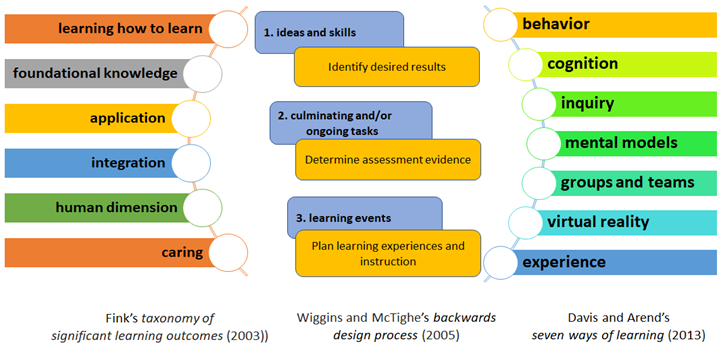
Source: Arau Ribeiro et al. (2020: 14)
The overall learning objectives are enriched through four lectures and twelve SEED Sustainability Challenges, each with six steps of design thinking tasks and tools. Each lecture proposes specific learning outcomes which are further developed in the specific learning outcomes of each challenge.
To consider the four different sets of learning objectives across the modules, the collected focuses for each of the four modules are copied in the table that follows. Based on the titles of the four modules across the top of the table, the columns that follow can be consulted to help you pick and choose as you build your own SEED course.
Learning Outcomes in each SEED module
|
Sustainability Unleashed |
Exploring |
Igniting |
Bringing Solutions |
|
Understand the foundational concepts of entrepreneurship and sustainability. |
Understand the importance of empathy in the context of sustainability challenges. |
Understand the importance of both critical and creative thinking in addressing and solving sustainability challenges in the context of entrepreneurship. |
Demonstrate the ability to create low-fidelity prototypes for sustainable solutions, applying practical skills in prototyping to visualize and test ideas. |
|
Explain the relationship between sustainability and entrepreneurship, particularly within the context of the Triple Bottom Line framework (People, Planet, Profit). |
Proficiently employ tools such as interviews and observations to conduct empathetic research. |
Develop the ability to effectively redefine sustainability problems, turning vague or complex issues into clear, actionable challenges ready for innovative solutions. |
Apply evaluation techniques that leverage constructive criticism and adaptability to elicit feedback/feedforward on prototypes to be incorporated into the iterative design process for refining and improving sustainable solutions. |
|
Familiarize themselves with the core principles of Design Thinking, including the 6 stages: Empathizing, Re-defining to Understand, Ideating, Prototyping, Evaluating, and Implementing. |
Effectively articulate and define sustainability problems for entrepreneurial solutions. |
Gain proficiency in ideation techniques such as brainstorming and mind mapping to find creative and practical solutions to sustainability challenges. |
Understand and execute the steps involved in implementing a sustainable solution, from developing a stable version of the product or service to launching it on the market. |
|
Develop an awareness of how Design Thinking can be applied to address sustainability challenges effectively. |
|
Grasp the fundamentals of the Circular Economy and the Sharing Economy to identify how these models can contribute to sustainable business solutions. |
Develop strategies for scaling sustainable solutions, including identifying potential barriers and opportunities along the path forward growth and impact amplification. |
|
Begin to cultivate a mindset conducive to empathetic problem-solving for sustainable entrepreneurship. |
|
Combine understanding of sustainability and innovation to create new businesses that are sustainable, profitable, and socially responsible. |
Measure the impact of sustainable solutions, utilizing appropriate metrics and tools to assess environmental, social, and economic benefits. |
|
|
|
Design-Thinking to accelerate solutions for the UN’s Sustainable Development Goals |
Exhibit an iterative design thinking mindset, recognizing the importance of continuous improvement and adaptation in the development of sustainable solutions. |